Apply a fraction or percentage to a quantity
By UK GCSE Mathematics · independent study · myAudience
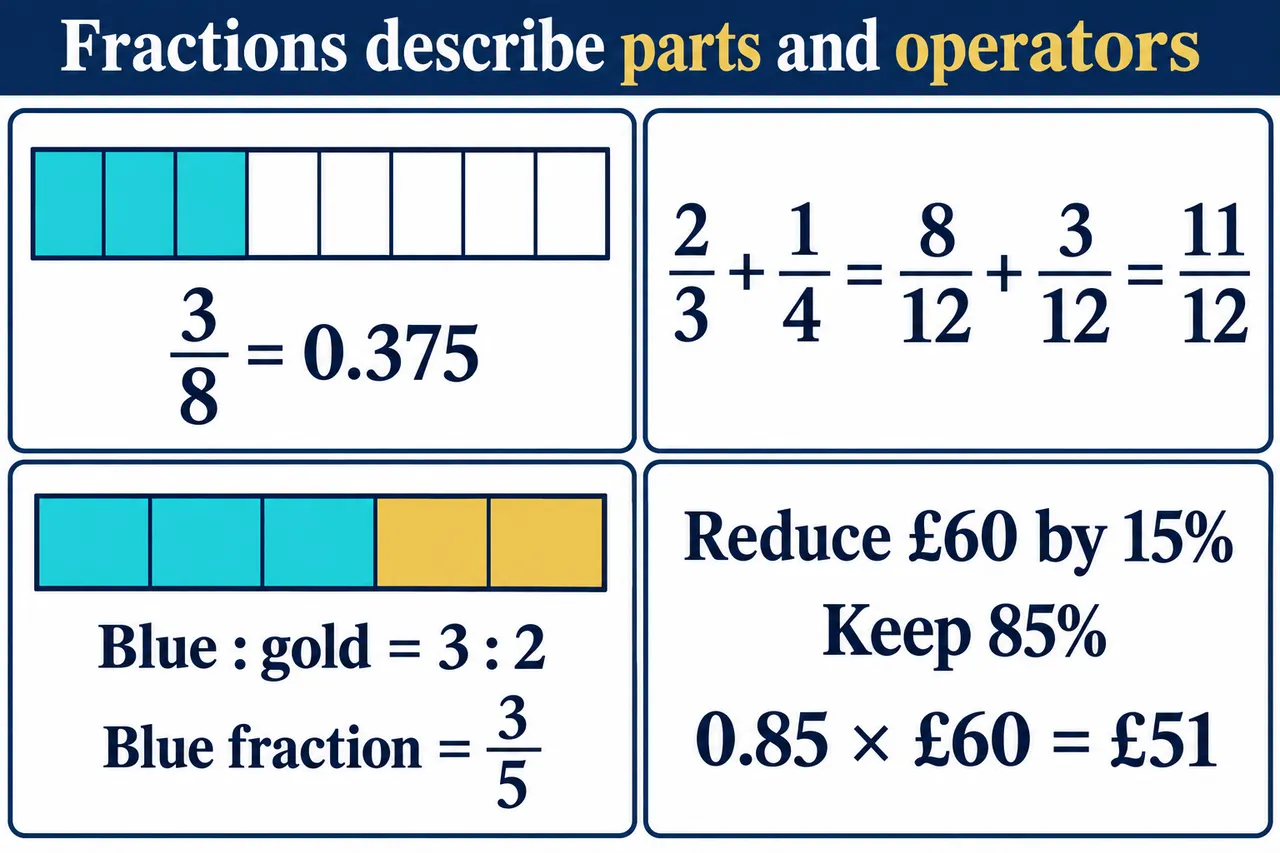
Original myAudience AI-generated mathematics teaching illustration; labels and relationships checked by the authoring agent. Independent integration review pending. · Original project artwork; no exam-board figures or textbook illustrations reused.
Apply a fraction or percentage to a quantity
A fraction used as an operator scales a quantity. Finding 3/4 of 28 means multiplying 28 by 3/4. Dividing by 4 then multiplying by 3 is the same operation and can make mental calculation easier.
A percentage operator is a fraction out of 100. Fifteen per cent of 80 is 0.15 × 80. Increasing a quantity by 15% uses the multiplier 1.15, while reducing it by 15% uses 0.85. The starting quantity is the reference whole.
Repeated percentage changes multiply rather than cancel additively. A 20% increase followed by a 20% reduction multiplies by 1.2 × 0.8 = 0.96, leaving 96% of the original. The second change is applied to a different whole.
Worked example: Reduce £60 by 15%.
Keep 85% of the original price.
Convert 85% to 0.85.
Calculate 60 × 0.85.
Answer: £51.
Check your understanding: What is 3/5 of 35?
Answer: 21.
Why: Divide 35 into five equal shares of 7, then take three.