Convert units without changing the quantity
By UK GCSE Mathematics · independent study · myAudience
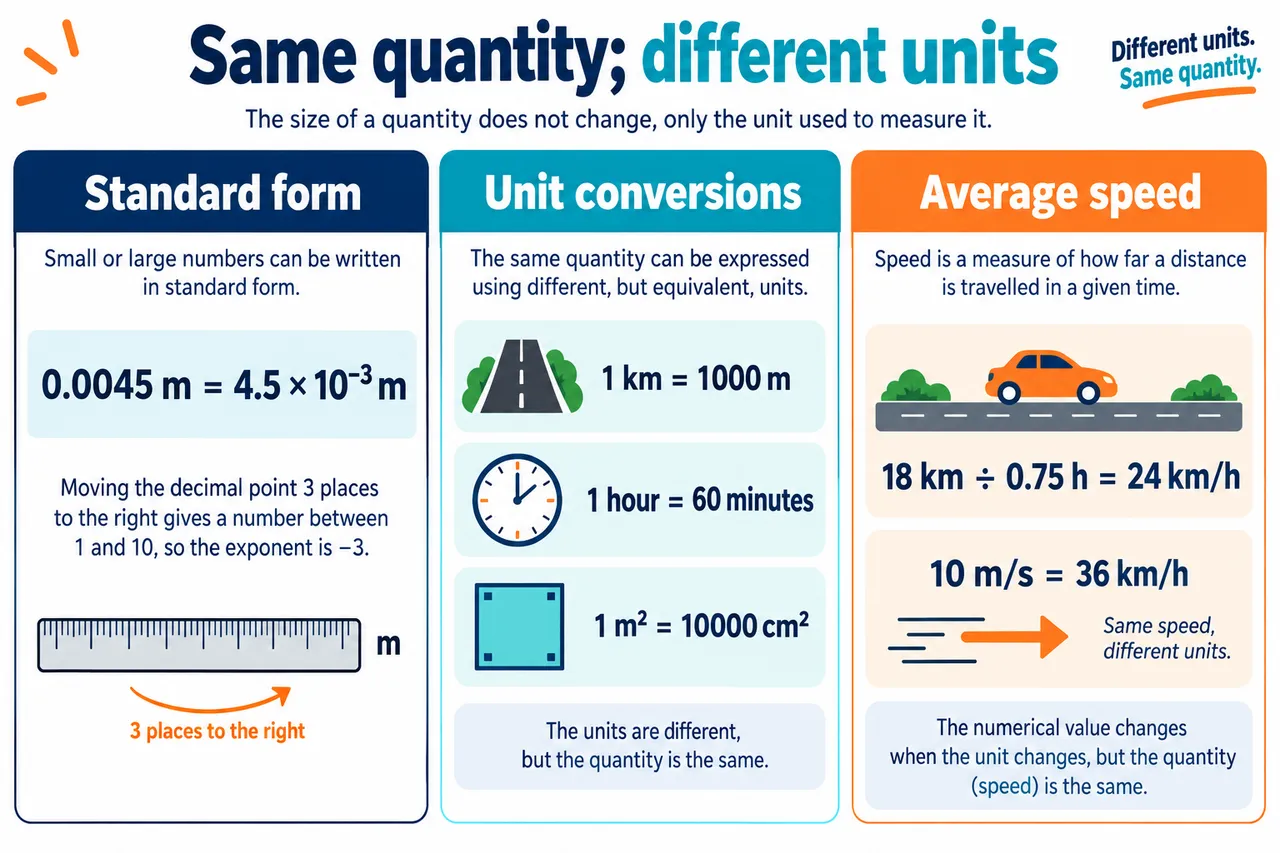
Original myAudience AI-generated mathematics teaching illustration; labels and relationships checked by the authoring agent. Independent integration review pending. · Original project artwork; no exam-board figures or textbook illustrations reused.
Convert units without changing the quantity
A numerical measurement needs a unit. Prefixes change the size of that unit: 1 km = 1000 m, 1 m = 100 cm and 1 kg = 1000 g. A smaller unit therefore requires more units to describe the same quantity.
Area and volume conversions apply the scale factor twice or three times. A square metre is 100 cm by 100 cm, so 1 m² = 10000 cm². A cubic metre contains 100³ cubic centimetres. Converting only once would confuse a length scale with an area or volume scale.
Time and money do not always follow the same decimal rule. One hour has 60 minutes, while one pound has 100 pence. A duration of 1.5 hours is 90 minutes, not 150 minutes. Identify the conversion relationship before multiplying or dividing.
Worked example: Convert 2.4 m² to cm².
One metre is 100 cm.
Square the length conversion: 1 m² = 100² cm².
Multiply 2.4 by 10000.
Answer: 24000 cm².
Check your understanding: Convert 0.75 hours to minutes.
Answer: 45 minutes.
Why: Multiply by 60 minutes per hour, rather than moving a decimal point.