Read rates and compound measures
By UK GCSE Mathematics · independent study · myAudience
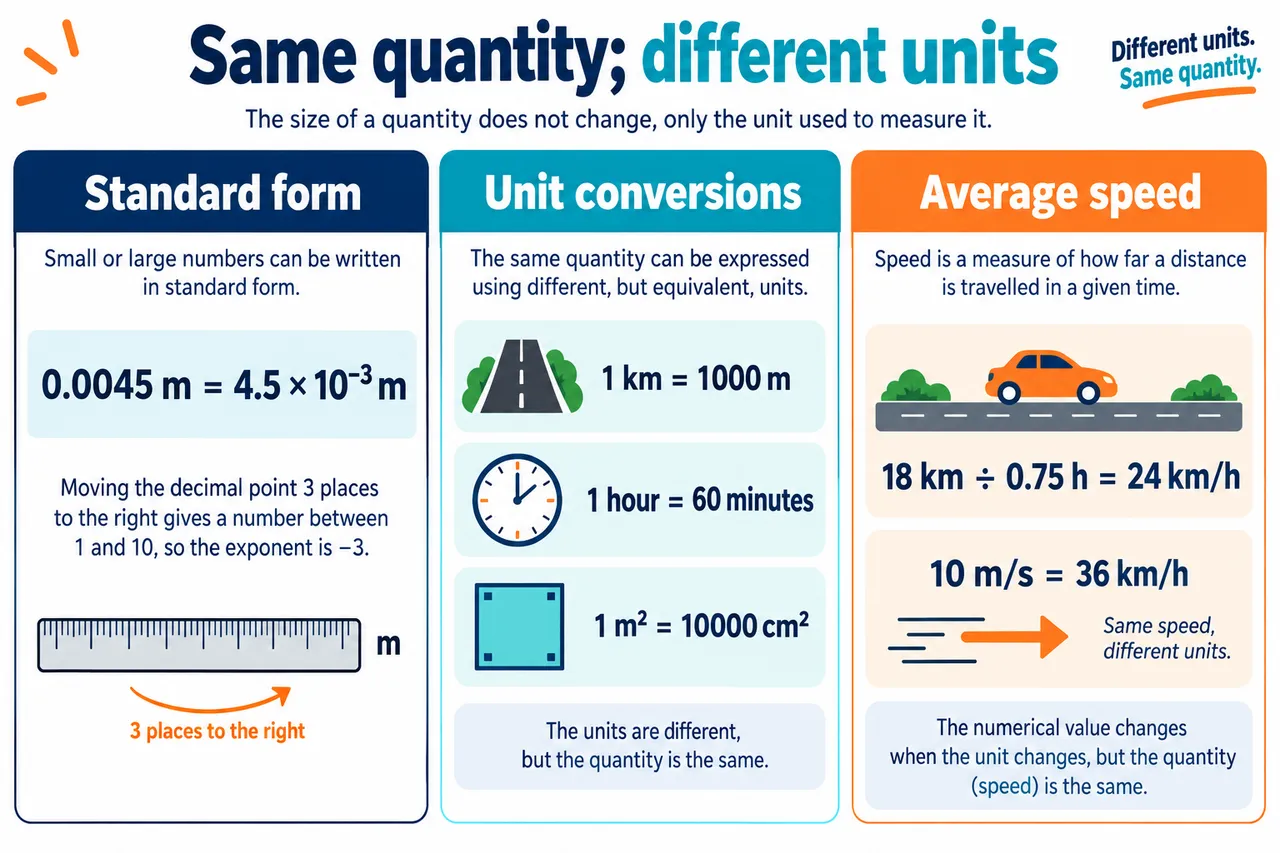
Original myAudience AI-generated mathematics teaching illustration; labels and relationships checked by the authoring agent. Independent integration review pending. · Original project artwork; no exam-board figures or textbook illustrations reused.
Read rates and compound measures
A compound measure combines quantities, often through division. Speed relates distance to time, density relates mass to volume, and unit price relates money to quantity. The units reveal which operation is needed.
Convert each part consistently when changing compound units. To convert m/s to km/h, multiply by 3600 seconds per hour and divide by 1000 metres per kilometre, giving a factor of 3.6. Converting only the distance or only the time leaves an incompatible measure.
Check whether the computed rate is an average over the whole interval or a value at an instant. A trip average uses total distance divided by total elapsed time. It is not generally the unweighted average of speeds achieved over unequal times.
Worked example: A cyclist travels 18 km in 45 minutes. Find the average speed in km/h.
Convert 45 minutes to 0.75 hours.
Divide 18 km by 0.75 h.
Answer: 24 km/h.
Check your understanding: Convert 10 m/s to km/h.
Answer: 36 km/h.
Why: There are 3600 seconds in an hour and 1000 metres in a kilometre, giving the factor 3.6.