Use estimates to catch implausible answers
By UK GCSE Mathematics · independent study · myAudience
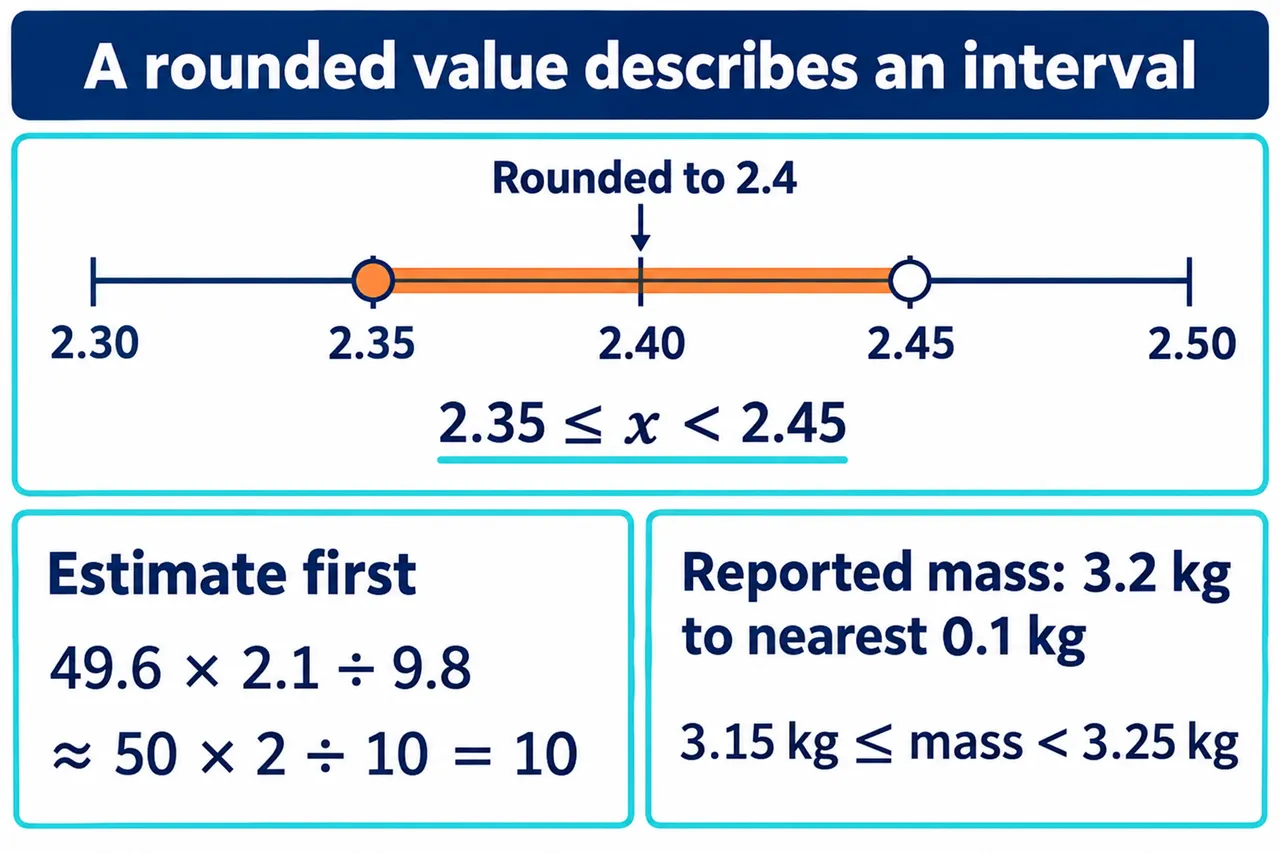
Original myAudience AI-generated mathematics teaching illustration; labels and relationships checked by the authoring agent. Independent integration review pending. · Original project artwork; no exam-board figures or textbook illustrations reused.
Use estimates to catch implausible answers
An estimate replaces awkward values with nearby convenient ones. The result is approximate, so record which values were changed. Rounding every input to one significant figure is a useful quick check, but a closer bound or another convenient approximation may be better for a particular problem.
An estimate checks scale, sign and plausible size. It does not prove the exact answer. If an estimated bill is around £40, a calculator result of £400 suggests a misplaced decimal or wrong input. A modest difference might simply reflect the approximation.
Where it matters, reason about the direction of the estimate. Increasing a positive numerator or decreasing a positive denominator increases a quotient. Using known limits can be more informative than uncontrolled rounding.
Worked example: Estimate 49.6 × 2.1 ÷ 9.8.
Replace 49.6 by 50, 2.1 by 2 and 9.8 by 10.
Calculate 50 × 2 ÷ 10.
Answer: About 10.
Check your understanding: Could 101.2 reasonably be the exact answer here?
Answer: No; it is about ten times the estimated scale.
Why: The approximation is close enough to flag a major factor-of-ten error, though not to certify the precise result.