Round values and describe their intervals
By UK GCSE Mathematics · independent study · myAudience
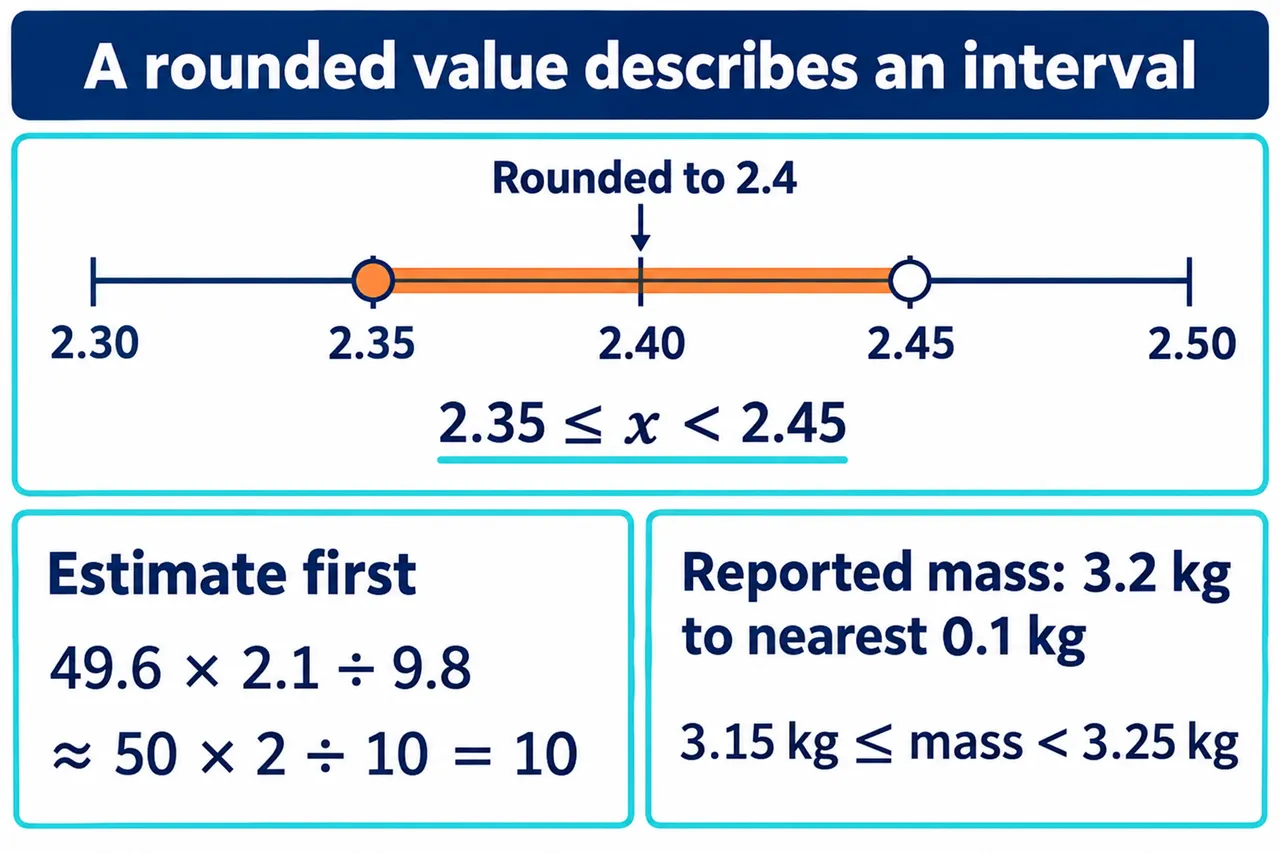
Original myAudience AI-generated mathematics teaching illustration; labels and relationships checked by the authoring agent. Independent integration review pending. · Original project artwork; no exam-board figures or textbook illustrations reused.
Round values and describe their intervals
Decimal places count positions after the decimal point. Significant figures begin at the first nonzero digit and describe the meaningful size of a number. To round, inspect the first discarded digit: 5 or more increases the last retained digit under the usual positive-number convention.
Rounding removes information. A positive value reported as 2.4 to the nearest tenth could originally be any value from 2.35 inclusive up to 2.45 exclusive. The interval spans half a rounding step on each side. Use inequality notation to retain which endpoints belong.
Truncation removes digits without rounding. For a positive value truncated to 2.4 at one decimal place, the interval is 2.4 ≤ x < 2.5. This differs from the rounding interval. For negative values, truncation towards zero needs separate care; do not blindly reuse the positive interval.
Worked example: Round 0.006784 to two significant figures.
The first significant digit is 6, not either leading zero.
Keep 6 and 7; the next digit 8 rounds 7 upward.
Answer: 0.0068.
Check your understanding: A positive length rounds to 8 cm to the nearest centimetre. Give its interval.
Answer: 7.5 cm ≤ length < 8.5 cm.
Why: Half a centimetre on either side captures all values that round to 8 under the usual rounding rule.