Interpret the precision of a reported measurement
By UK GCSE Mathematics · independent study · myAudience
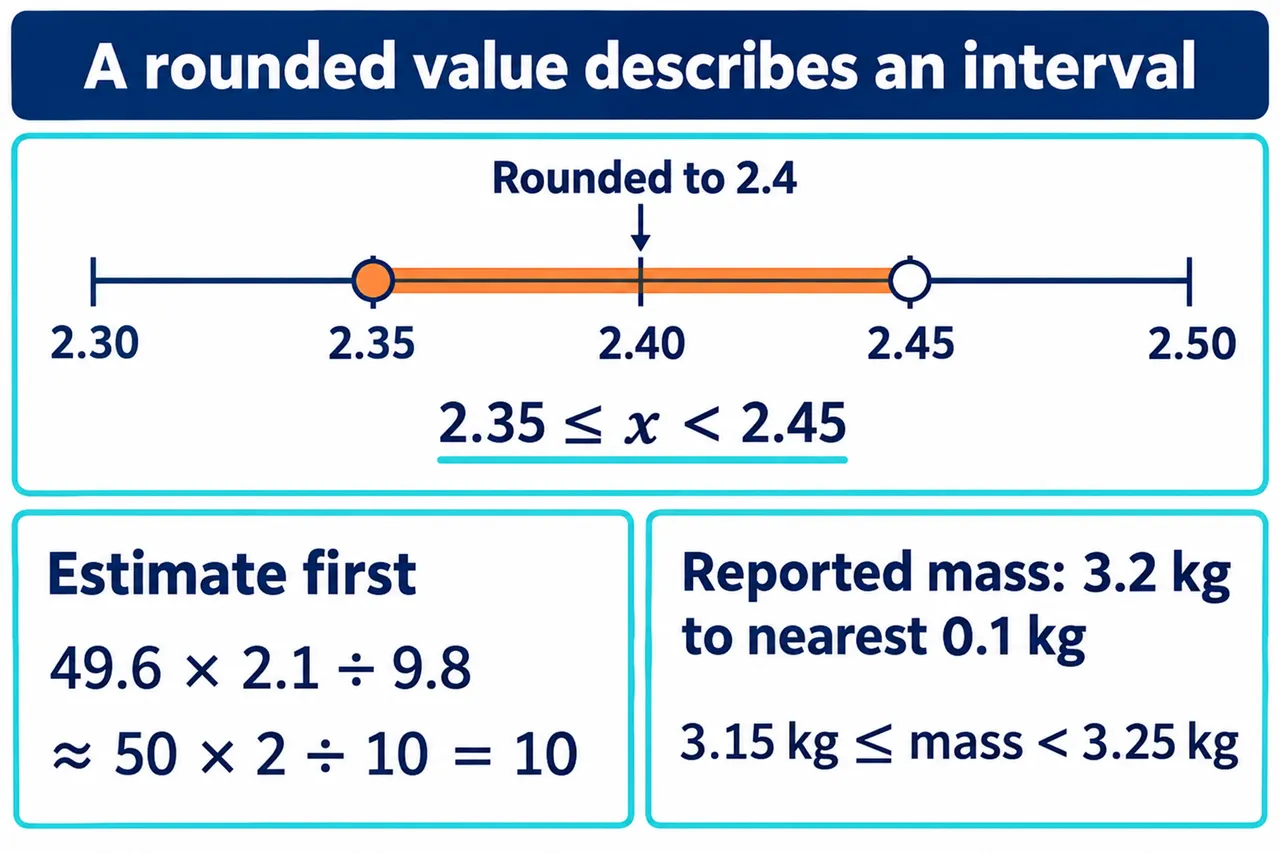
Original myAudience AI-generated mathematics teaching illustration; labels and relationships checked by the authoring agent. Independent integration review pending. · Original project artwork; no exam-board figures or textbook illustrations reused.
Interpret the precision of a reported measurement
A rounded measurement describes an interval, not an infinitely precise value. The size of the reporting step determines the limits. Reporting a mass to the nearest 0.1 kg is more precise than reporting it to the nearest kilogram, even if both displayed numbers look similar.
Accuracy and precision are related but different ideas. More decimal places describe finer reporting precision, but an incorrectly calibrated instrument can still give a value far from the true quantity. Do not infer perfect accuracy from a long calculator display.
Use the original reporting information when deciding how many digits to give a derived answer. Rounding too early can accumulate avoidable error. Keep working values and round at the end; explain a requested error interval rather than presenting an estimated value as exact.
Worked example: A mass is 3.2 kg to the nearest 0.1 kg. State the possible values.
The reporting step is 0.1 kg, so half a step is 0.05 kg.
Subtract and add 0.05 to 3.2.
Include the lower endpoint and exclude the upper one under the stated rounding convention.
Answer: 3.15 kg ≤ mass < 3.25 kg.
Check your understanding: Does writing 3.200 kg prove the measurement was made to the nearest 0.001 kg?
Answer: No.
Why: Trailing zeros alone do not establish how the measurement was taken; the reporting precision must be stated.