Count linked choices with a product
By UK GCSE Mathematics · independent study · myAudience
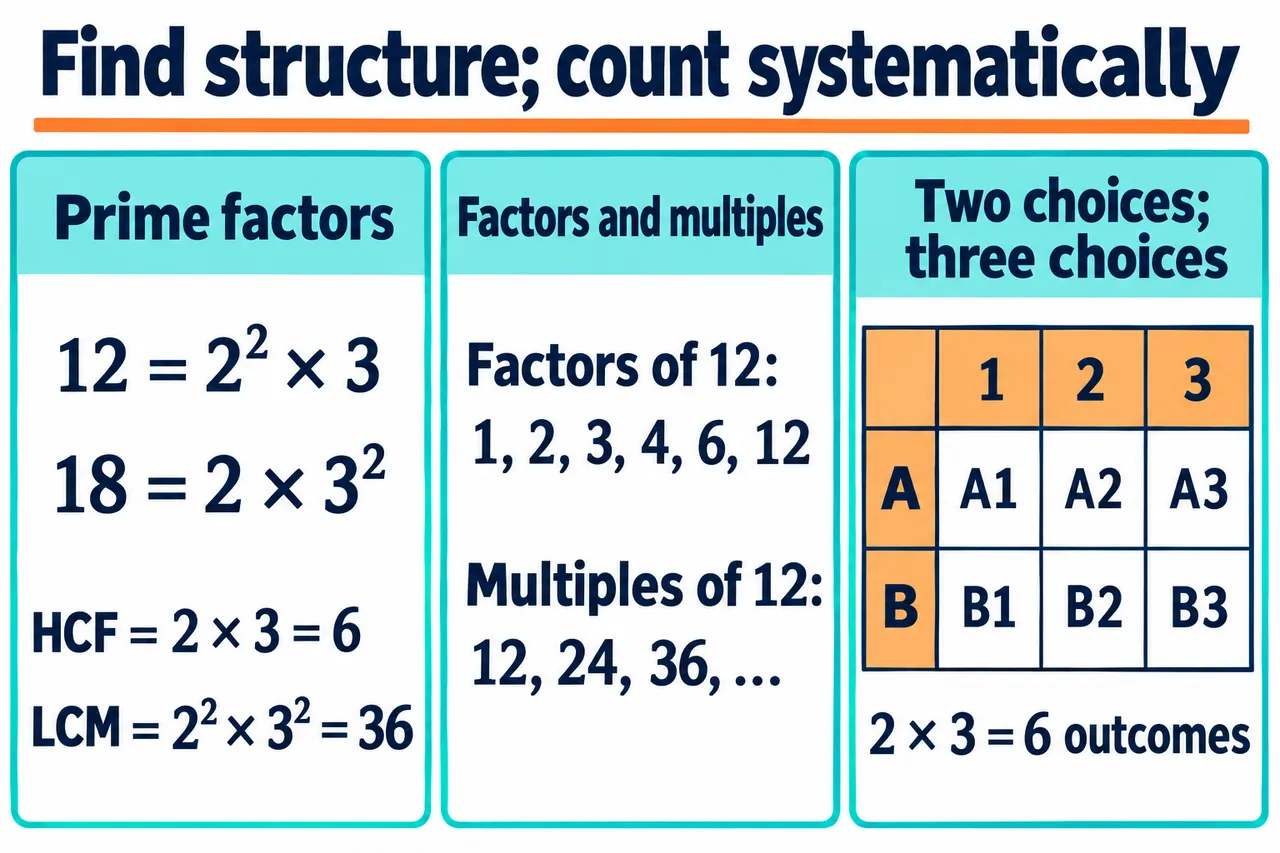
Original myAudience AI-generated mathematics teaching illustration; labels and relationships checked by the authoring agent. Independent integration review pending. · Original project artwork; no exam-board figures or textbook illustrations reused.
Count linked choices with a product
If every first choice permits the same number of second choices, an outcome table has equal-length rows. Multiplying the number of rows by the number of entries per row gives the total. This is the product rule for counting.
The rule depends on the restrictions. A two-digit code with repetition permitted has ten choices in each position, giving 100 codes including leading zeros. If repetition is forbidden, the second position has only nine choices. If a code must be a two-digit number, the first digit cannot be zero, changing the count again.
Worked example: How many outfits use 3 shirts, 2 trousers and 2 jackets?
Each shirt permits 2 × 2 = 4 trouser/jacket combinations.
There are 3 shirt choices, each with four outcomes.
Answer: 12 outfits.
Check your understanding: How many ordered two-letter codes use A, B, C without repeated letters?
Answer: 6.
Why: There are three first choices and two remaining second choices: 3 × 2.