Locate a root between familiar powers
By UK GCSE Mathematics · independent study · myAudience
Original myAudience AI-generated mathematics teaching illustration; labels and relationships checked by the authoring agent. Independent integration review pending. · Original project artwork; no exam-board figures or textbook illustrations reused.
Locate a root between familiar powers
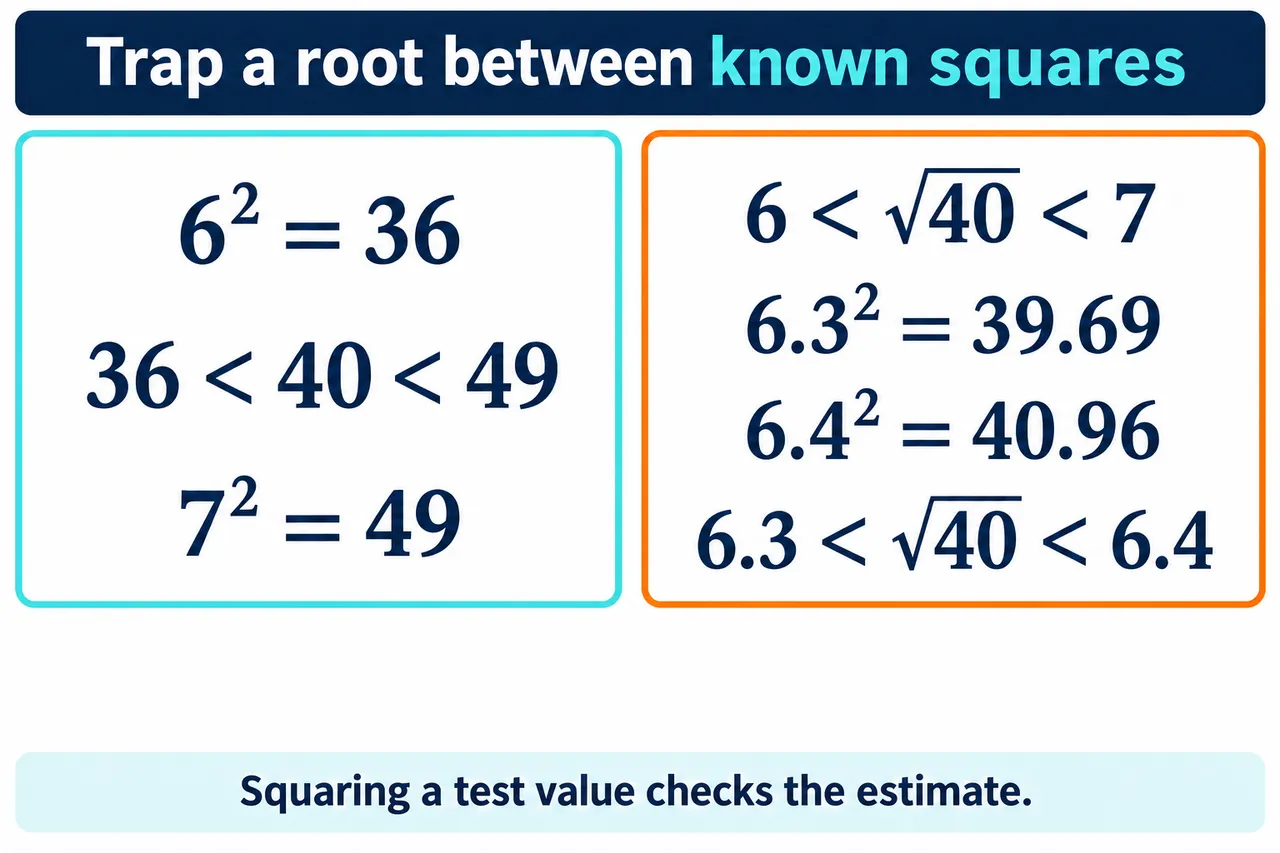
To estimate a positive square root, compare the number with neighbouring perfect squares. Since 6² = 36 and 7² = 49, √40 lies between 6 and 7. The root is nearer 6 because 40 is closer to 36, although distance between squares is not a linear root scale.
Refine an estimate by testing decimals through squaring. For √40, 6.3² = 39.69 and 6.4² = 40.96, so the root lies between 6.3 and 6.4. The same bounding idea works with positive higher powers, provided the power function is increasing on the positive interval.
Worked example: Locate √50 between consecutive integers.
Compare 7² = 49 and 8² = 64.
Because 49 < 50 < 64, take positive square roots.
Answer: 7 < √50 < 8.
Check your understanding: Is ∛30 between 3 and 4?
Answer: Yes.
Why: 3³ = 27 and 4³ = 64; cubing is increasing for these positive numbers.