Read fractional powers as roots
By UK GCSE Mathematics · independent study · myAudience
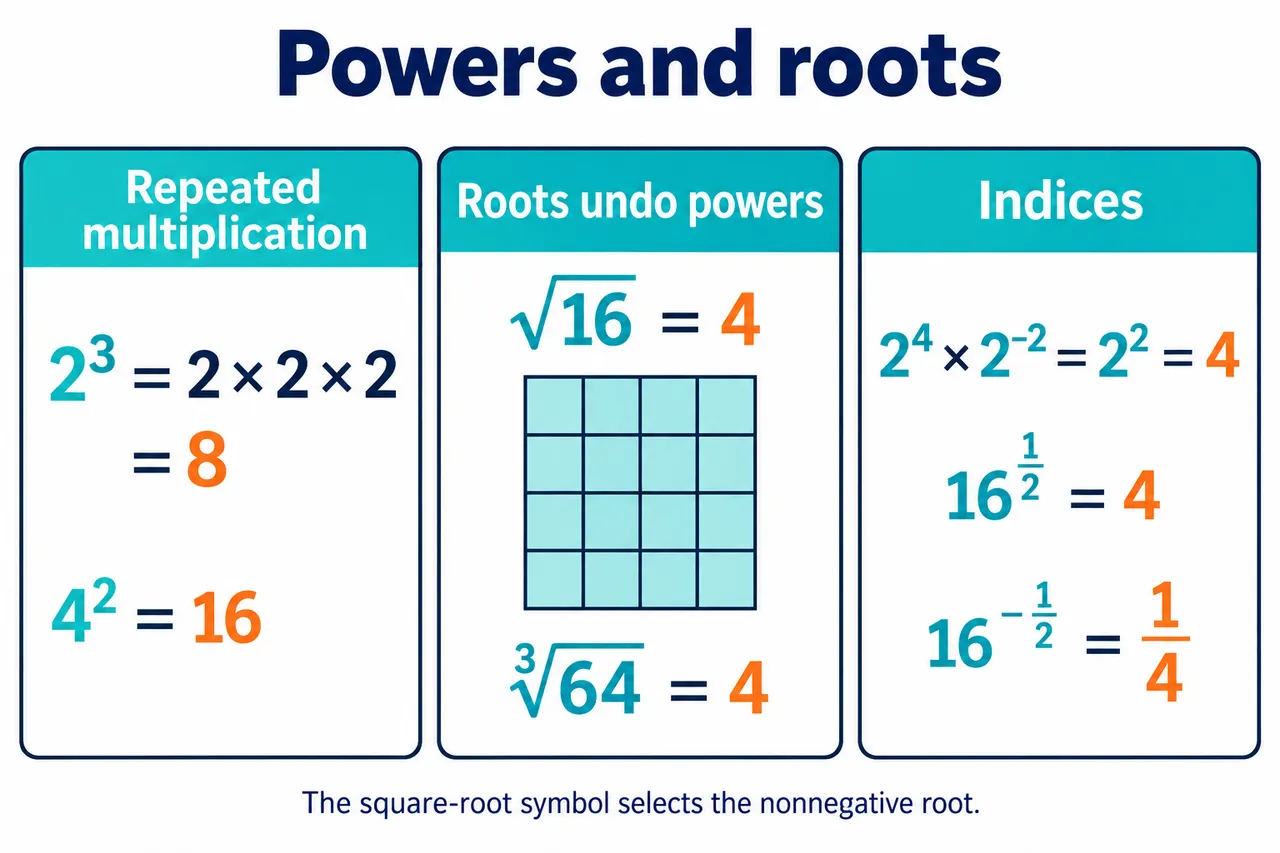
Original myAudience AI-generated mathematics teaching illustration; labels and relationships checked by the authoring agent. Independent integration review pending. · Original project artwork; no exam-board figures or textbook illustrations reused.
Read fractional powers as roots
For a positive base, a^(1/n) denotes the positive nth root. A power a^(m/n) can be found by taking that root and then raising it to the integer power m. This extension preserves the index laws while connecting powers to roots.
A negative fractional index adds a reciprocal. For example, 16^(−1/2) is 1/√16 = 1/4. Keep the base positive in this GCSE model; arbitrary negative bases with fractional exponents require domain care and cannot all be treated as real values.
Worked example: Calculate 27^(2/3).
Take the cube root of 27 to obtain 3.
Square 3.
Answer: 9.
Check your understanding: What is 25^(−1/2)?
Answer: 1/5.
Why: The half power gives the positive square root 5; the negative sign in the exponent takes its reciprocal.