Simplify roots without approximating them
By UK GCSE Mathematics · independent study · myAudience
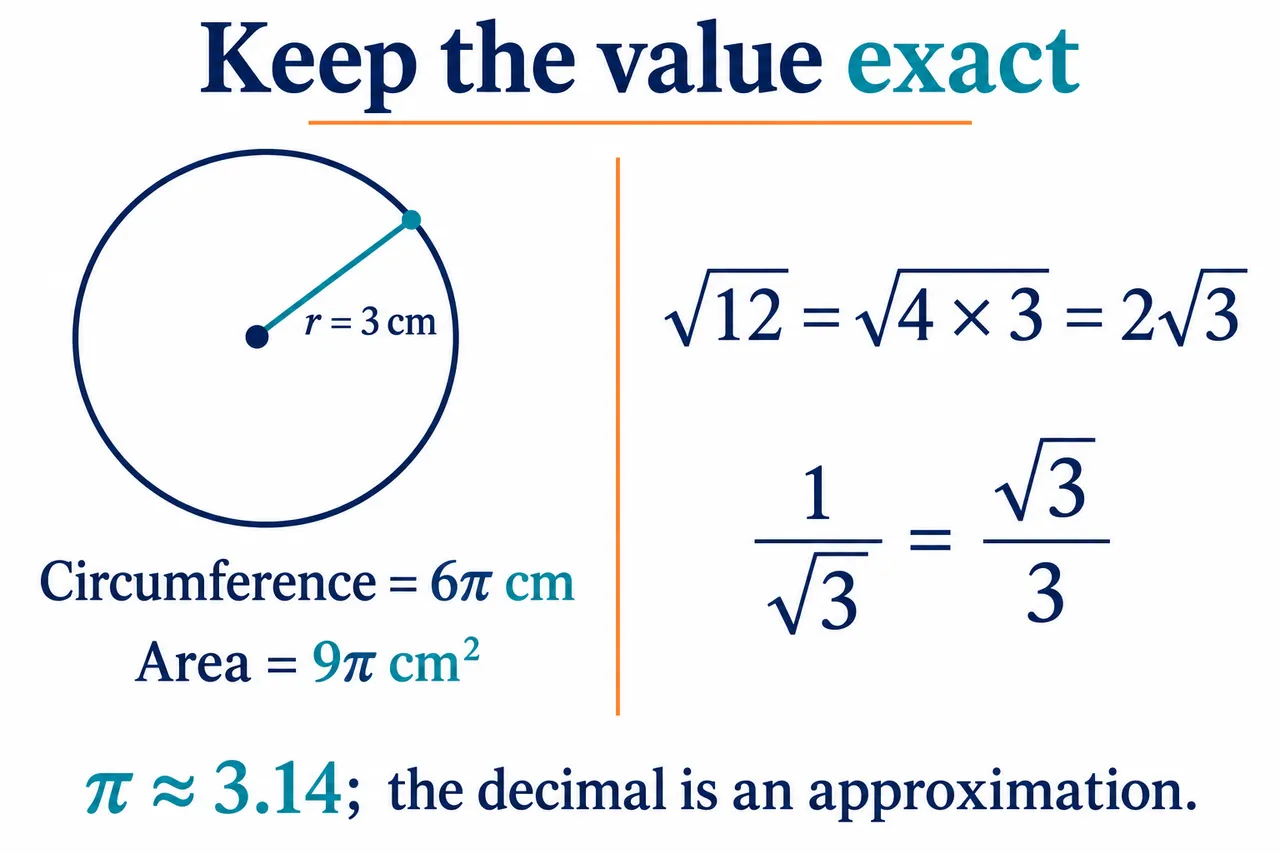
Original myAudience AI-generated mathematics teaching illustration; labels and relationships checked by the authoring agent. Independent integration review pending. · Original project artwork; no exam-board figures or textbook illustrations reused.
Simplify roots without approximating them
A surd retains an irrational root exactly. Factor a square number from under a positive square root: √12 = √(4 × 3) = 2√3. Combining like surds then works like combining like algebraic terms. Unlike surds do not become a single sum under one root.
Rationalising a denominator rewrites a fraction with no surd in its denominator while preserving its value. Multiply numerator and denominator by the same nonzero expression. For a two-term denominator, its conjugate uses the opposite sign so that the middle terms cancel in the product.
The difference-of-squares identity explains the conjugate method: (a+b)(a−b)=a²−b². Check the denominator before simplifying. These transformations keep an exact value; a decimal approximation can be supplied afterwards if required.
Worked example: Rationalise 1/(√3 + 1).
Multiply numerator and denominator by √3 − 1.
The denominator becomes 3 − 1 = 2.
Answer: (√3 − 1)/2.
Check your understanding: Simplify √20 + √45.
Answer: 5√5.
Why: √20 = 2√5 and √45 = 3√5, so their coefficients add.