Convert a recurring decimal to an exact fraction
By UK GCSE Mathematics · independent study · myAudience
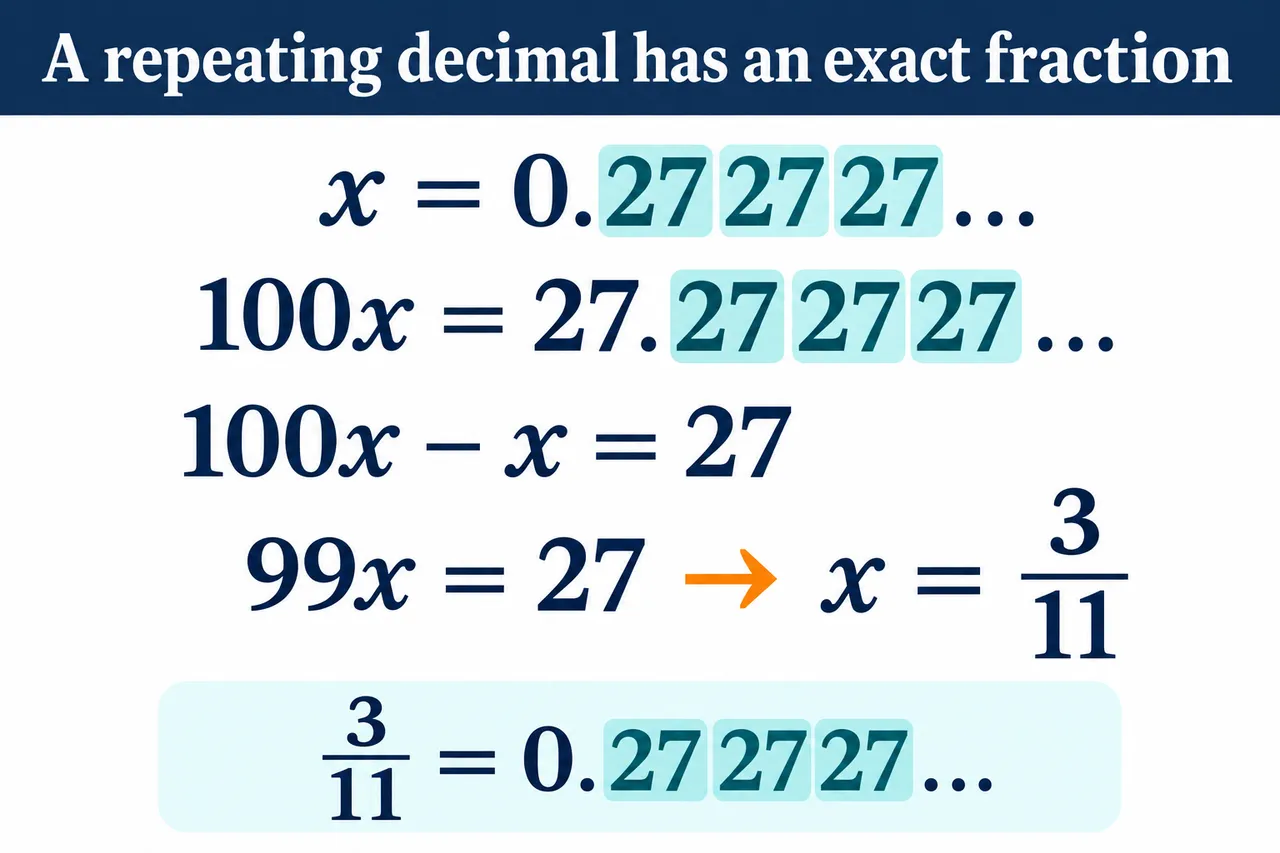
Original myAudience AI-generated mathematics teaching illustration; labels and relationships checked by the authoring agent. Independent integration review pending. · Original project artwork; no exam-board figures or textbook illustrations reused.
Convert a recurring decimal to an exact fraction
A recurring decimal repeats a digit block indefinitely. A finite calculator display is not the full recurring value. To find its fraction, multiply by a power of ten that shifts one full repeat block, then subtract matching tails.
If a non-repeating prefix comes first, create two shifted expressions with identical recurring tails before subtracting. The method is algebraic cancellation of the same infinite tail, not a claim that a long finite decimal is exact. Reduce the resulting fraction.
Worked example: Convert 0.272727… to a fraction.
Let x = 0.272727….
Two digits repeat, so 100 x = 27.272727….
Subtract x: 99 x = 27, then divide and reduce 27/99.
Answer: 3/11.
Check your understanding: Convert 0.166666… to a fraction.
Answer: 1/6.
Why: Let x equal the decimal; 100 x − 10 x = 15, so 90 x = 15.