Bound a calculation from rounded measurements
By UK GCSE Mathematics · independent study · myAudience
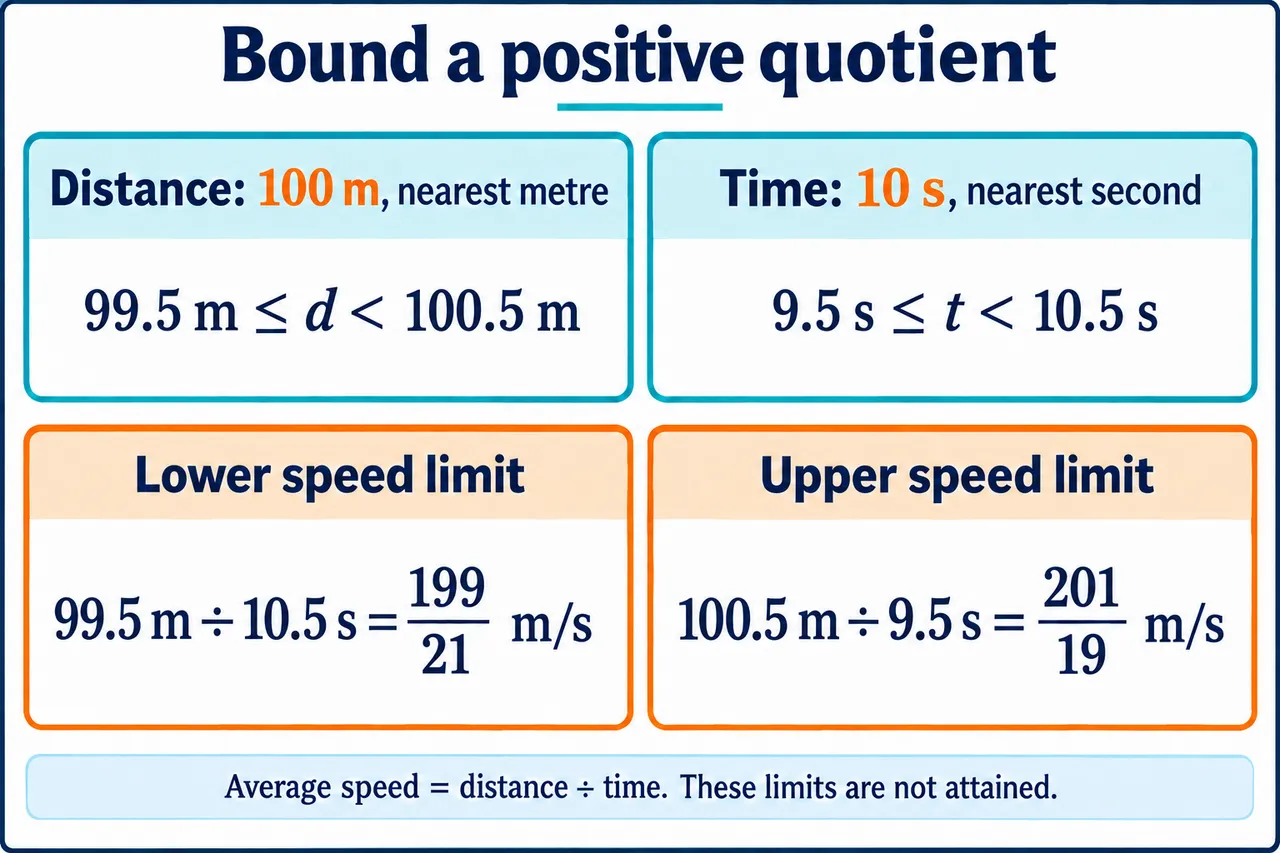
Original myAudience AI-generated mathematics teaching illustration; labels and relationships checked by the authoring agent. Independent integration review pending. · Original project artwork; no exam-board figures or textbook illustrations reused.
Bound a calculation from rounded measurements
For positive quantities, a product increases when either factor increases. A quotient increases with its numerator and decreases with its denominator. This gives different choices for lower and upper bounds: a maximum quotient uses the largest numerator and smallest denominator.
Keep endpoints and units explicit. Some upper limits are not attainable because their input intervals exclude an endpoint; they still provide a valid strict bound. The rules here assume positive denominators. If an interval crosses zero or signs change, simple positive-quantity formulas cannot be reused blindly.
A bound and a best estimate answer different questions. Using displayed values gives a nominal result; using extreme possible values gives guaranteed limits under the stated measurement assumptions. Round bounds outward if a coarser guaranteed enclosure is needed.
Worked example: Distance is 100 m to the nearest metre; time is 10 s to the nearest second. Bound the average speed.
Distance satisfies 99.5 ≤ d < 100.5 m; time satisfies 9.5 ≤ t < 10.5 s.
The lower limit is 99.5/10.5 = 199/21 m/s.
The upper limit is 100.5/9.5 = 201/19 m/s.
Answer: (199/21) m/s < speed < (201/19) m/s; approximately 9.476 to 10.579 m/s.
Check your understanding: For positive a/b, which values make the quotient largest?
Answer: The largest permitted a and the smallest permitted positive b.
Why: Increasing the numerator raises the quotient; increasing the denominator lowers it.