Read the shorthand of algebra
By UK GCSE Mathematics · independent study · myAudience
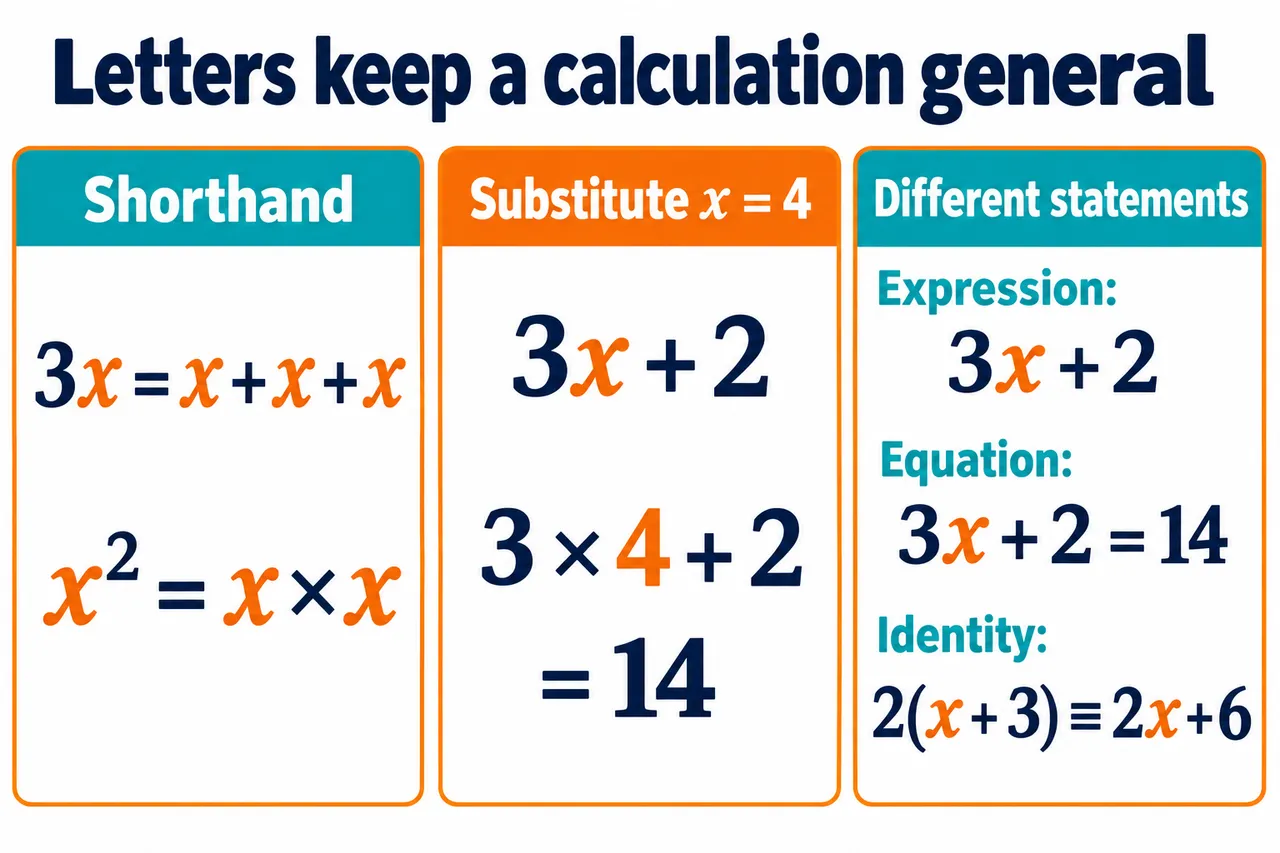
Original myAudience AI-generated mathematics teaching illustration; labels and relationships checked by the authoring agent. Independent integration review pending. · Original project artwork; no exam-board figures or textbook illustrations reused.
Read the shorthand of algebra
A letter can stand for a number that is unknown or allowed to vary. Writing 3x means 3 multiplied by x, not a two-digit number. The expressions x² and x³ describe repeated multiplication. A fraction bar can represent division by a nonzero denominator, and brackets identify a grouped quantity.
A coefficient multiplies a term. In 3x², the coefficient is 3 and the power applies to x. In (3x)², the brackets make the entire product the base, giving 9x². A coefficient such as 1/2 can be kept as a fraction, preserving an exact value.
Write expressions so another reader can recover the intended operations. The statement ab means a × b; a/b requires b ≠ 0. The expressions a+b and ab are different even when an unusual choice of numbers happens to make their values equal.
Worked example: Write x+x+x and a×a×b in compact notation.
Three identical x terms combine to 3x.
Two factors of a give a²; retain the separate b factor.
Answer: 3x and a²b.
Check your understanding: Are 3x² and (3x)² generally equal?
Answer: No: the second is 9x².
Why: In the second expression the square applies to the coefficient as well as x.