Replace variables and keep the operations
By UK GCSE Mathematics · independent study · myAudience
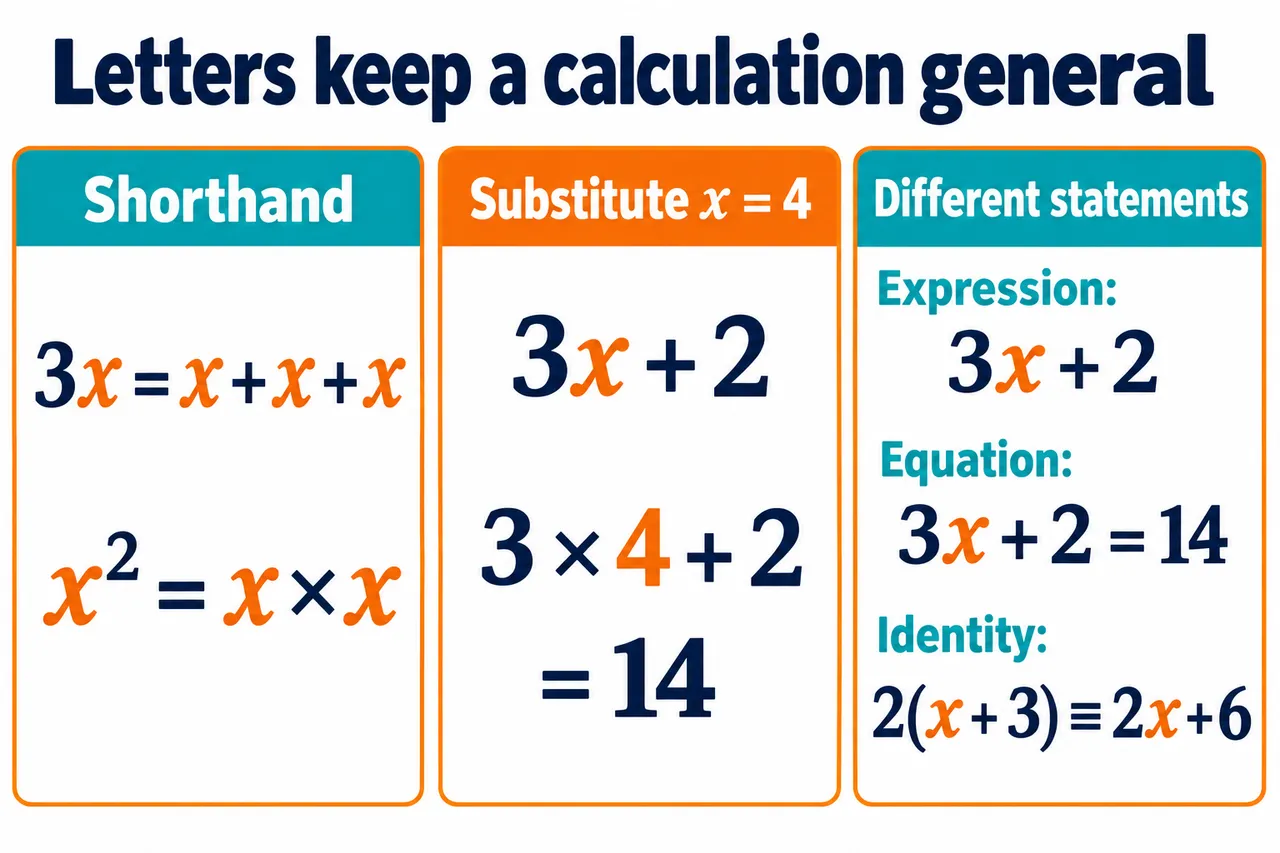
Original myAudience AI-generated mathematics teaching illustration; labels and relationships checked by the authoring agent. Independent integration review pending. · Original project artwork; no exam-board figures or textbook illustrations reused.
Replace variables and keep the operations
Substitution assigns a stated number to each variable without changing the structure of the expression. Use brackets when replacing a letter with a negative value. This prevents a minus sign from being mistaken for an operation outside a power.
Scientific formulae also need consistent units. In s = ut + (1/2)at², a time in seconds must fit the units of velocity and acceleration. Calculate powers before multiplication, retain working precision, and interpret the answer in the quantity requested.
A formula can give different answers as its inputs vary; substitution evaluates one particular case. Check the result against an estimate or the original context, especially where a measurement cannot sensibly be negative.
Worked example: Evaluate 2x²−3x when x=−2.
Substitute with brackets: 2(−2)²−3(−2).
The square is 4, so the first term is 8.
The second term is −(−6), which adds 6.
Answer: 14.
Check your understanding: What is 3x+2 when x=4?
Answer: 14.
Why: Multiply 3 by 4 before adding 2.