Distinguish expressions, equations and identities
By UK GCSE Mathematics · independent study · myAudience
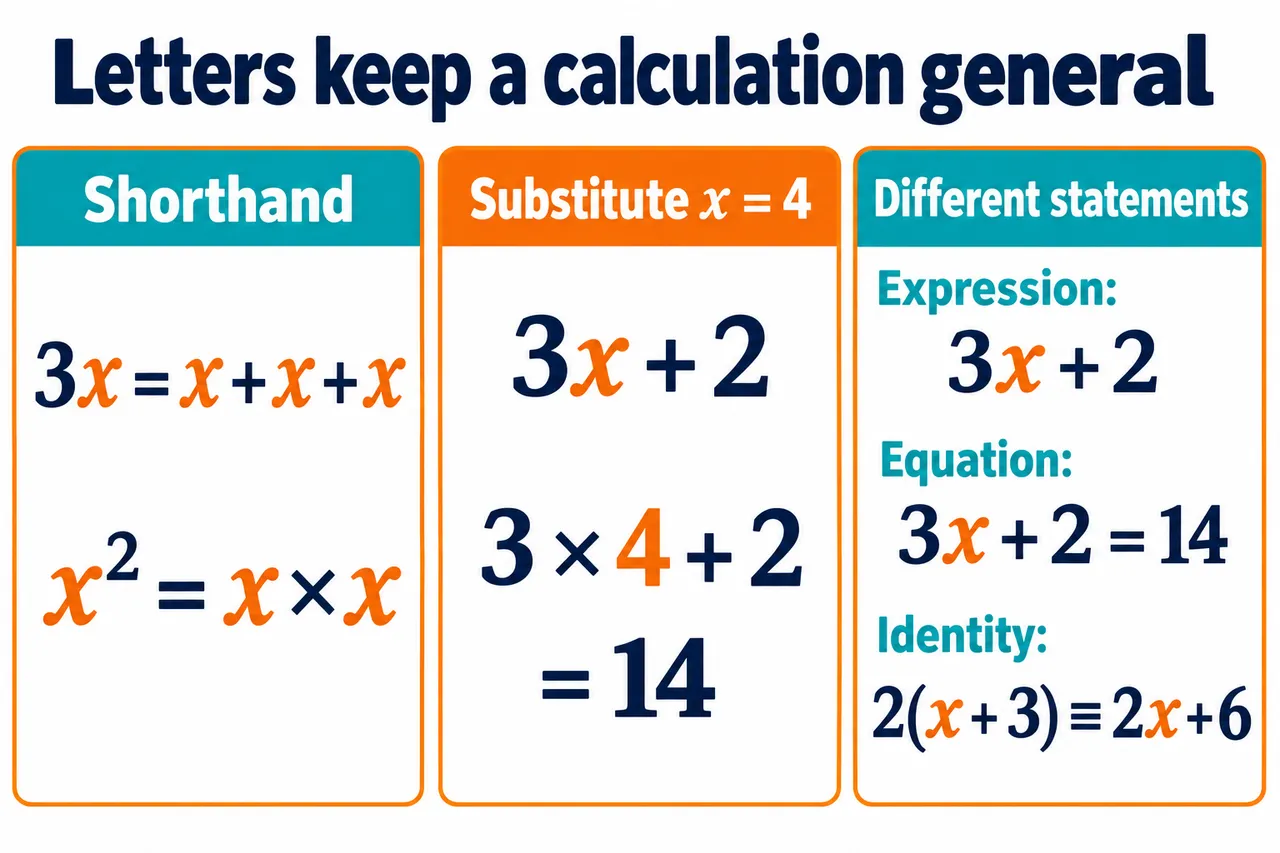
Original myAudience AI-generated mathematics teaching illustration; labels and relationships checked by the authoring agent. Independent integration review pending. · Original project artwork; no exam-board figures or textbook illustrations reused.
Distinguish expressions, equations and identities
An expression names a value through numbers, variables and operations. An equation states that two expressions are equal and may hold only for particular inputs. A formula expresses a relationship between quantities, often using an equation.
An identity is true for every allowed input, such as 2(x+3) ≡ 2x+6. An inequality compares sizes rather than asserting equality. The allowed domain still matters: expressions containing division cannot use a denominator of zero.
Terms are separated by addition or subtraction at the relevant top level; factors are multiplied. In 3x+2, the terms are 3x and 2, while 3 and x are factors of the first term. In 3(x+2), the bracket is one whole factor.
Worked example: Classify 3x+2, 3x+2=14 and 2(x+3)≡2x+6.
The first gives a value without a relational sign.
The second is an equation satisfied by x=4.
The third is an identity explained by distribution.
Answer: Expression; equation; identity.
Check your understanding: Are x+2 and x×2 the same kind of combination?
Answer: No: one is a sum; the other is a product.
Why: Terms in a sum and factors in a product support different manipulation rules.