Combine terms with matching variable structure
By UK GCSE Mathematics · independent study · myAudience
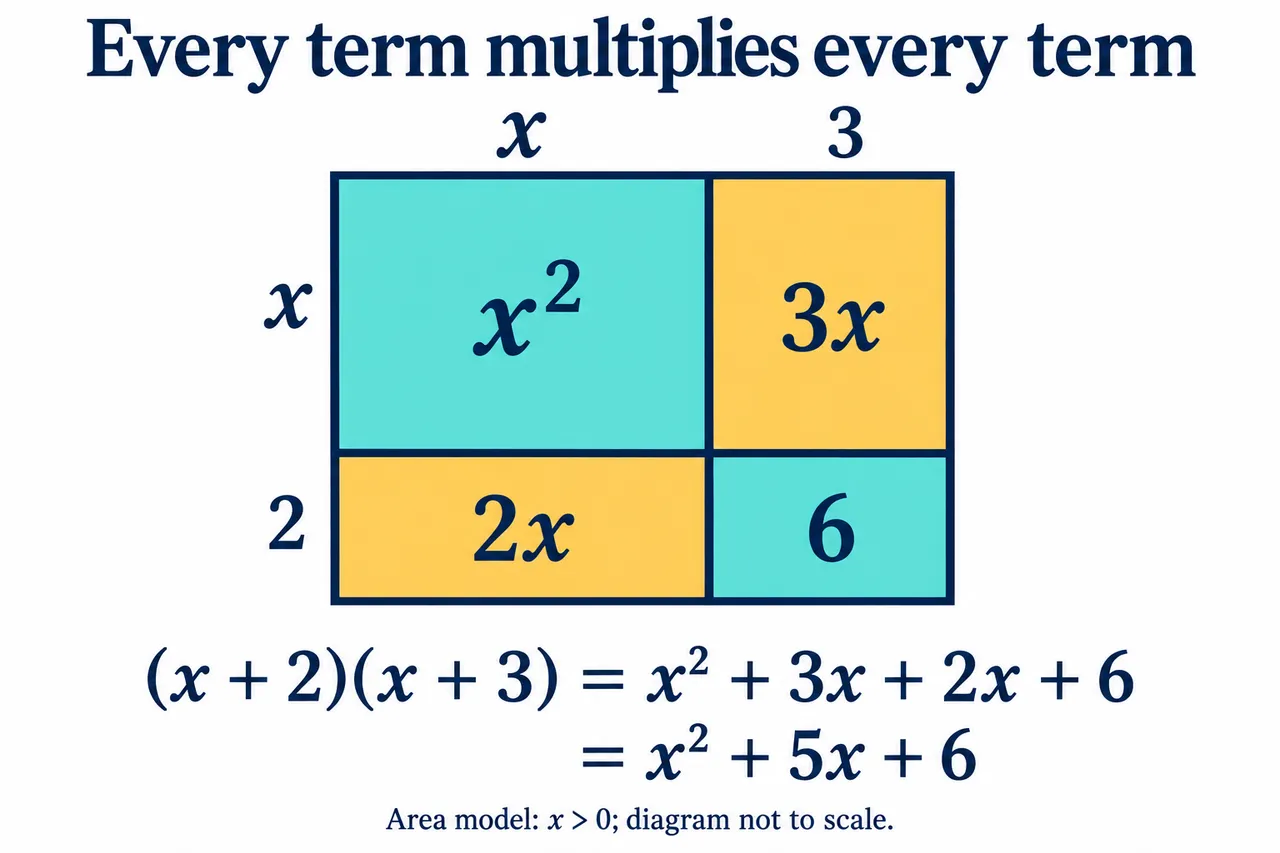
Original myAudience AI-generated mathematics teaching illustration; labels and relationships checked by the authoring agent. Independent integration review pending. · Original project artwork; no exam-board figures or textbook illustrations reused.
Combine terms with matching variable structure
Like terms contain exactly the same variable factors raised to the same powers. You can combine 3x and 5x because each counts copies of x. You cannot combine 3x and 5x² into 8x or 8x²: their variable structures differ.
Coefficients carry their signs. In 4x−7x+2x, combine 4−7+2 to obtain−1, leaving−x. Constants combine separately. The same reasoning applies to matching surds: 2√3+5√3 = 7√3.
Products use factor structure rather than the addition rule. Multiplying 3x by 2x gives 6x², because both coefficients and variable factors multiply. Keeping sums and products separate avoids a common false cancellation.
Worked example: Simplify 3x²+4x−x²−7x+5.
Combine square terms: 3x²−x² = 2x².
Combine linear terms: 4x−7x = −3x.
Retain the constant 5.
Answer: 2x²−3x+5.
Check your understanding: Simplify 4a×3a².
Answer: 12a³.
Why: Multiply coefficients and add exponents for the same variable base.