Distribute a factor and reverse the operation
By UK GCSE Mathematics · independent study · myAudience
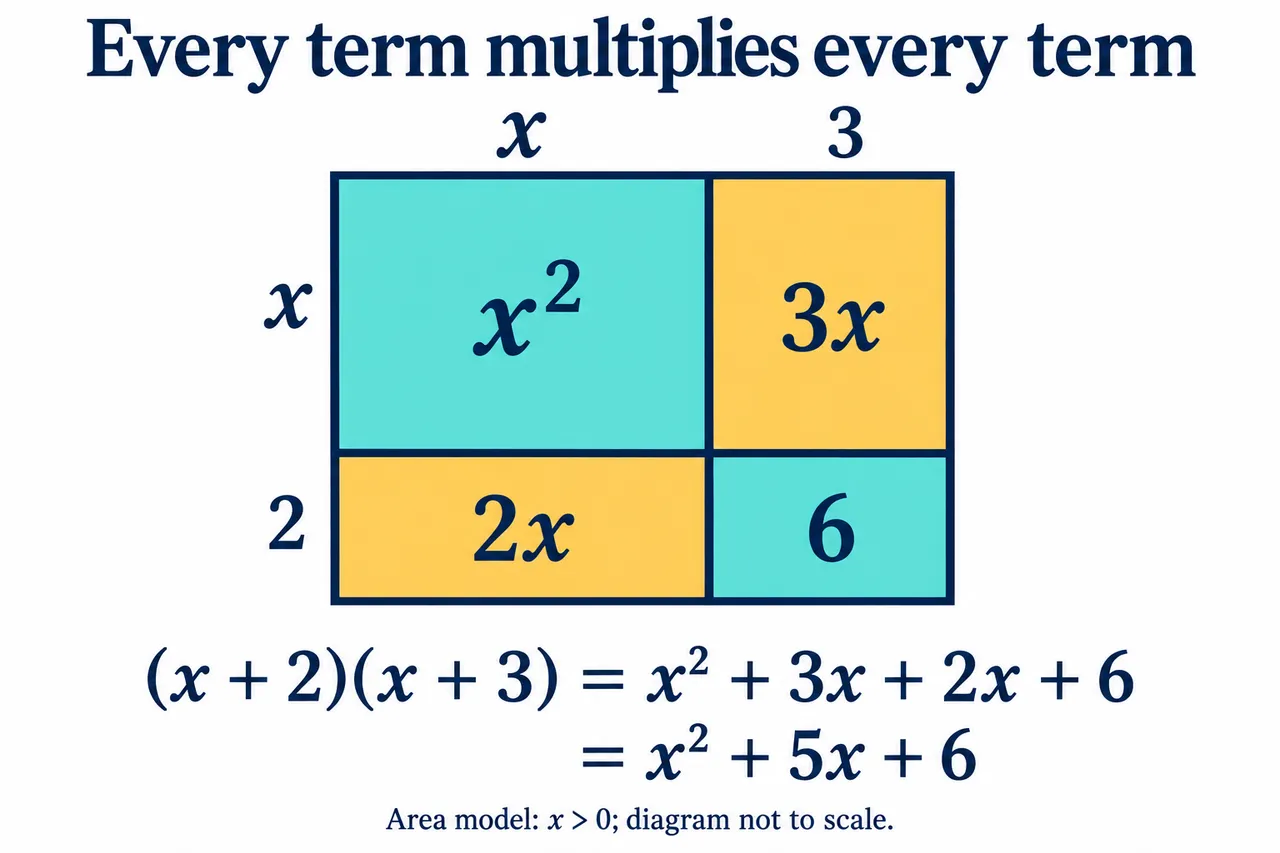
Original myAudience AI-generated mathematics teaching illustration; labels and relationships checked by the authoring agent. Independent integration review pending. · Original project artwork; no exam-board figures or textbook illustrations reused.
Distribute a factor and reverse the operation
A factor outside a bracket multiplies every term inside. Thus 3(x+2)=3x+6. A negative multiplier changes each sign: −2(x−4)=−2x+8. Expanding means replacing the product with its equivalent sum.
Factorising reverses distribution. Find a common factor of every term and divide each term by it inside the bracket. For 6x+9, factorising 3 gives 3(2x+3). Expanding the answer is a direct check that no term or sign was lost.
An area model can make distribution visible for positive lengths, but the algebraic identity is more general. A rectangle with side x and total width x+3 has areas x² and 3x. It illustrates x(x+3)=x²+3x when x is positive; negative values are handled algebraically, not as physical lengths.
Worked example: Expand −3(2x−5), then factorise 8x+12.
Multiply−3 by 2x and by−5.
For 8x+12, take out the common factor 4.
Answer: −6x+15;4(2x+3).
Check your understanding: Does 2(x+4) equal 2x+4?
Answer: No; it equals 2x+8.
Why: The outside factor multiplies both terms in the bracket.