Expand and factorise simple quadratics
By UK GCSE Mathematics · independent study · myAudience
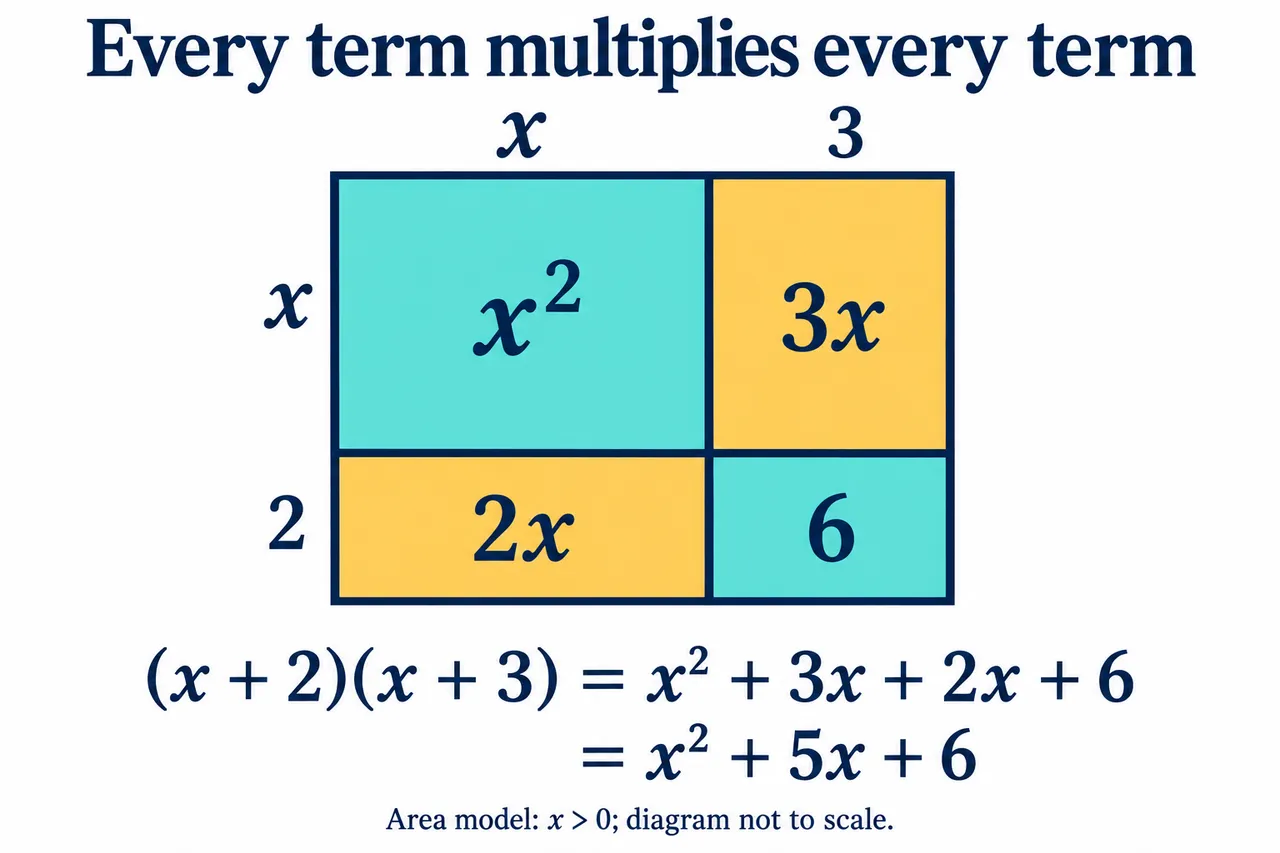
Original myAudience AI-generated mathematics teaching illustration; labels and relationships checked by the authoring agent. Independent integration review pending. · Original project artwork; no exam-board figures or textbook illustrations reused.
Expand and factorise simple quadratics
When two binomials multiply, every term in one bracket multiplies every term in the other. For (x+2)(x+3), the four products are x², 3x, 2x and 6. Combining the middle terms gives x²+5x+6.
To reverse this for x²+bx+c, seek two numbers whose sum is b and product is c. Their signs determine both conditions. Checking only the product can give a factorisation with the wrong linear coefficient.
The difference of two squares is a useful special identity: a²−b²=(a−b)(a+b). The middle terms cancel during expansion. A sum of two squares does not follow that same real-factor pattern.
Worked example: Factorise x²+x−6.
Find numbers with product−6 and sum 1:3 and −2.
Use the brackets(x+3)(x−2).
Expand to check x²−2x+3x−6.
Answer: (x+3)(x−2).
Check your understanding: Factorise x²−25.
Answer: (x−5)(x+5).
Why: It is a difference of squares, with 25=5².