Show why a relationship holds
By UK GCSE Mathematics · independent study · myAudience
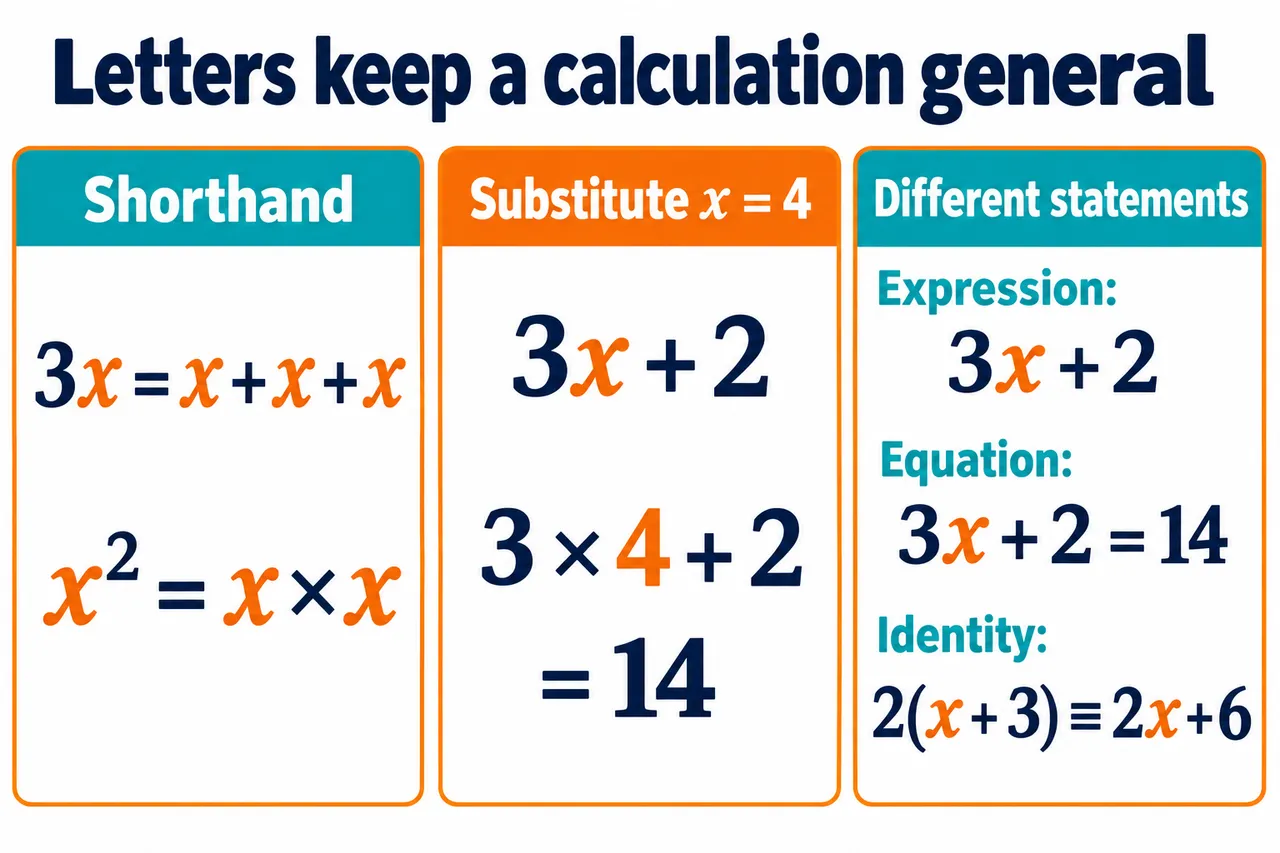
Original myAudience AI-generated mathematics teaching illustration; labels and relationships checked by the authoring agent. Independent integration review pending. · Original project artwork; no exam-board figures or textbook illustrations reused.
Show why a relationship holds
Checking a few values can reveal a pattern or disprove a universal claim, but it cannot establish an identity for every input. Algebraic reasoning follows from general expressions and valid transformations.
A representation makes the domain explicit. Write an even integer as 2n, where n is an integer. The next even integer is 2n+2. Their sum is 4n+2=2(2n+1), which has a factor 2 and is therefore even. The factorisation explains all permitted cases at once.
A counterexample needs only one permitted case where a claimed universal statement fails. For example, n²+n+1 is not always prime: n=4 gives 21. Explain why the chosen value is within the claimed domain and why the result contradicts the assertion.
Worked example: Show that the sum of two odd integers is even.
Represent the odd integers as 2m+1 and 2n+1, with m, n integers.
Add to obtain 2m+2n+2.
Factorise 2(m+n+1).
Answer: The sum is even because it is twice an integer.
Check your understanding: Does checking n=1, 2, 3 prove a formula for all integers?
Answer: No.
Why: Those checks cover only three cases; a general argument or relevant proof is needed.