Treat an expression as an input-output rule
By UK GCSE Mathematics · independent study · myAudience
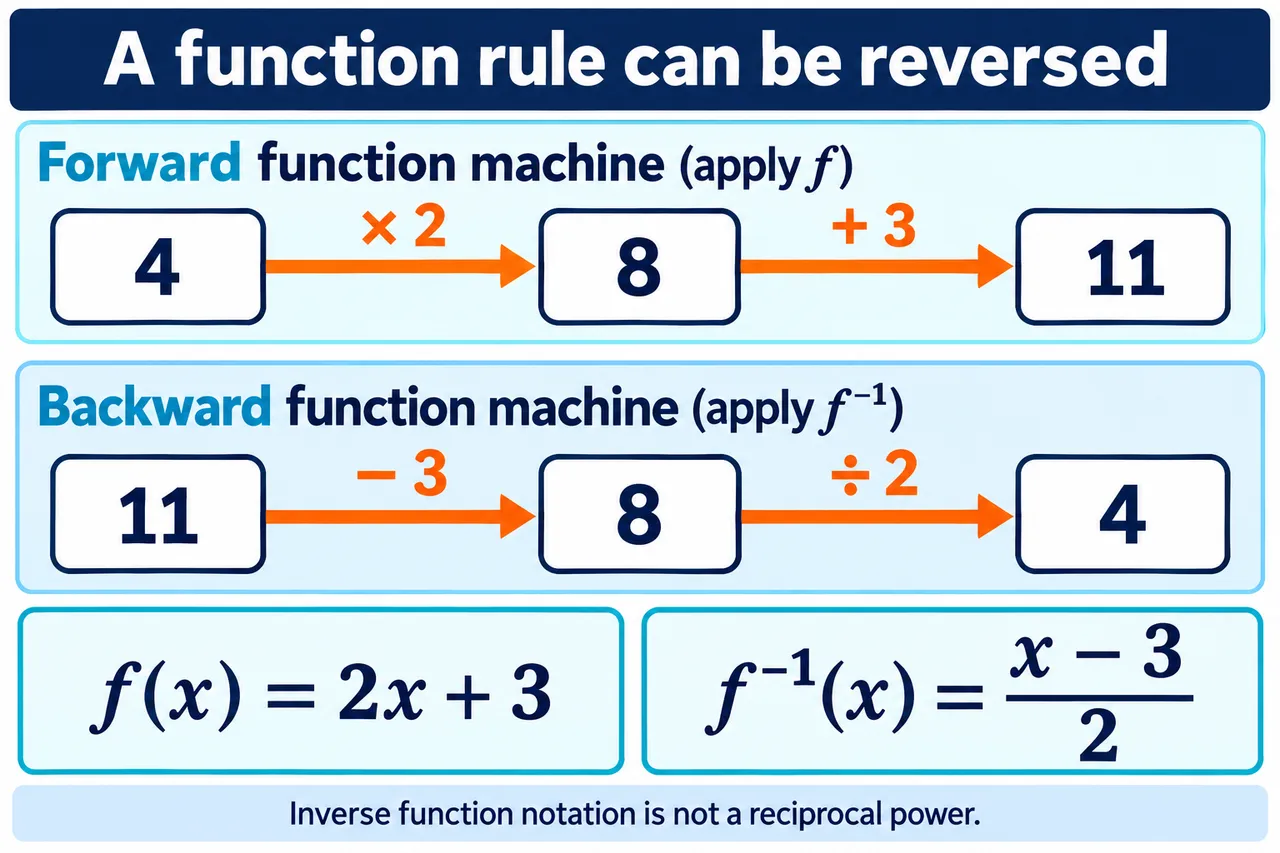
Original myAudience AI-generated mathematics teaching illustration; labels and relationships checked by the authoring agent. Independent integration review pending. · Original project artwork; no exam-board figures or textbook illustrations reused.
Treat an expression as an input-output rule
A function assigns one output to each permitted input. The rule 2x+3 first doubles the input, then adds 3. A table records individual input-output pairs, while the expression describes the same process for every input in the domain.
Different inputs can sometimes share an output. The squaring function gives 9 from both 3 and −3. This does not stop it being a function: each individual input still has exactly one output. It does matter when trying to reverse the rule.
Use a function machine to keep the order of operations visible. Multiplying then adding is usually different from adding then multiplying. The domain and output meaning should be stated when a rule models a real quantity.
Worked example: Apply the rule 2x+3 to input 4.
Double 4 to obtain 8.
Add 3.
Answer: 11.
Check your understanding: Does x² give one output for input−3?
Answer: Yes: 9.
Why: A function permits different inputs with the same output, but not two different outputs for a single permitted input.