Factorise a quadratic with a non-unit leading coefficient
By UK GCSE Mathematics · independent study · myAudience
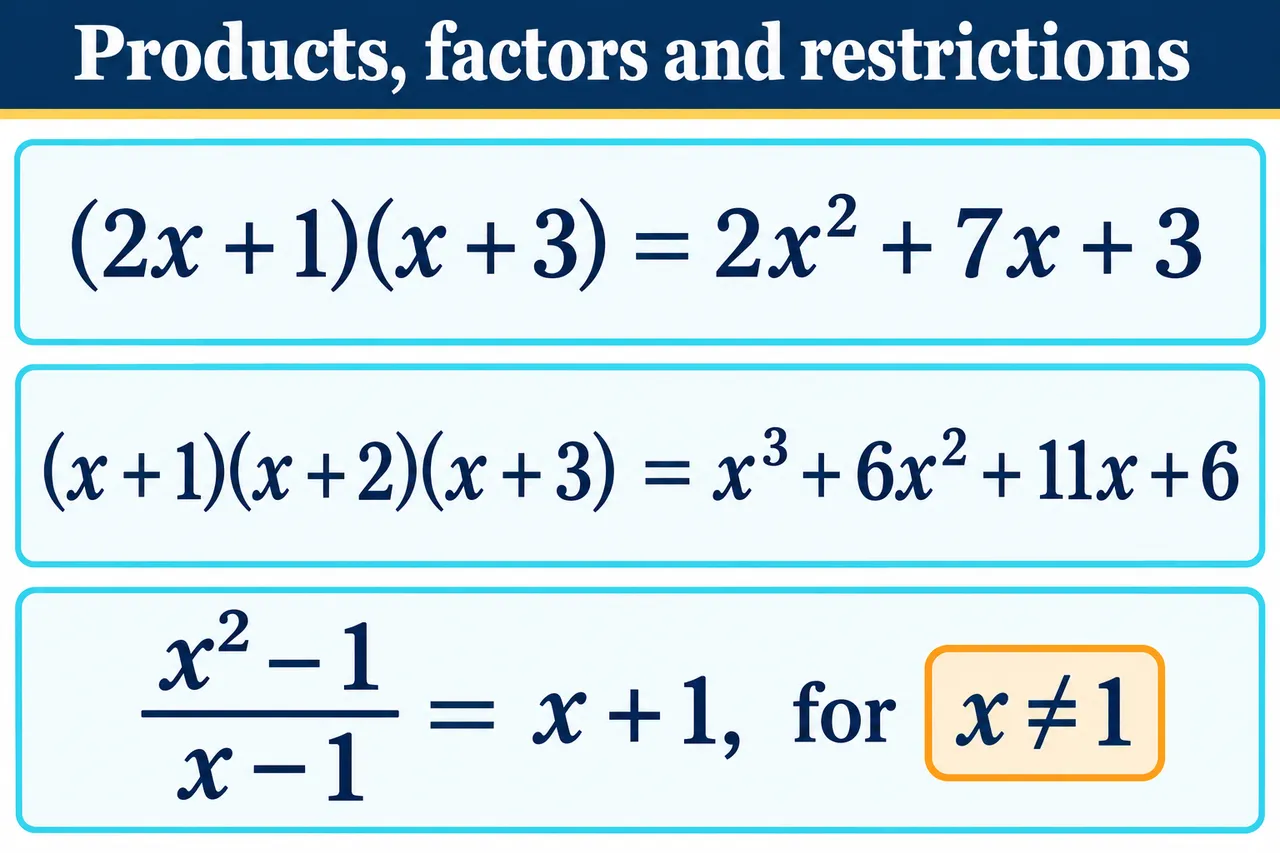
Original myAudience AI-generated mathematics teaching illustration; labels and relationships checked by the authoring agent. Independent integration review pending. · Original project artwork; no exam-board figures or textbook illustrations reused.
Factorise a quadratic with a non-unit leading coefficient
For ax²+bx+c, the first coefficient affects both brackets. One reliable method splits the middle term into two whose coefficients multiply to ac and add to b. Grouping then exposes a common binomial factor.
For 2x²+7x+3, ac=6 and the useful pair is 6 and 1. Rewrite 7x as 6x+x, then factorise the two groups. Expanding the final brackets checks the leading, middle and constant coefficients together.
Worked example: Factorise 2x²+7x+3.
Split the middle: 2x²+6x+x+3.
Factorise the groups: 2x(x+3)+1(x+3).
Take out the shared bracket.
Answer: (2x+1)(x+3).
Check your understanding: Expand (3x−2)(x+1).
Answer: 3x²+x−2.
Why: The four products give 3x²+3x−2x−2.