Multiply more than two brackets in stages
By UK GCSE Mathematics · independent study · myAudience
Original myAudience AI-generated mathematics teaching illustration; labels and relationships checked by the authoring agent. Independent integration review pending. · Original project artwork; no exam-board figures or textbook illustrations reused.
Multiply more than two brackets in stages
A product of three binomials can be evaluated in two stages. Expand two brackets and collect like terms, then multiply every term of that result by each term of the remaining bracket. Distribution applies to the whole intermediate expression.
The degree provides a scale check: multiplying three linear expressions usually produces a cubic when their leading coefficients are nonzero. A missing middle product can change a coefficient without changing the degree, so a substitution check is useful as well.
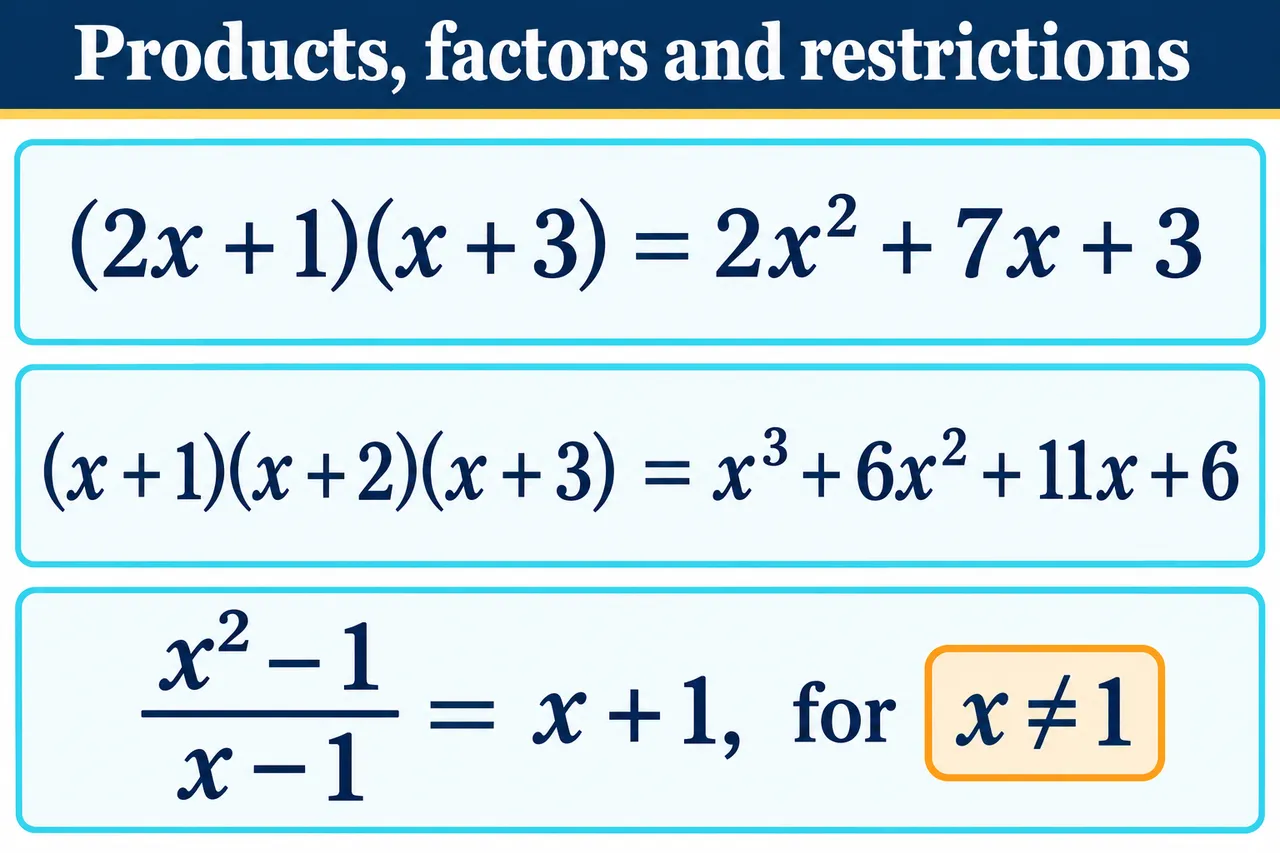
Worked example: Expand (x+1)(x+2)(x+3).
First (x+1)(x+2)=x²+3x+2.
Multiply by (x+3): x³+3x²+3x²+9x+2x+6.
Collect matching powers.
Answer: x³+6x²+11x+6.
Check your understanding: What constant term should this product have?
Answer: 6.
Why: The constant contribution comes from 1×2×3; substituting x=0 checks it.