Simplify rational expressions while keeping restrictions
By UK GCSE Mathematics · independent study · myAudience
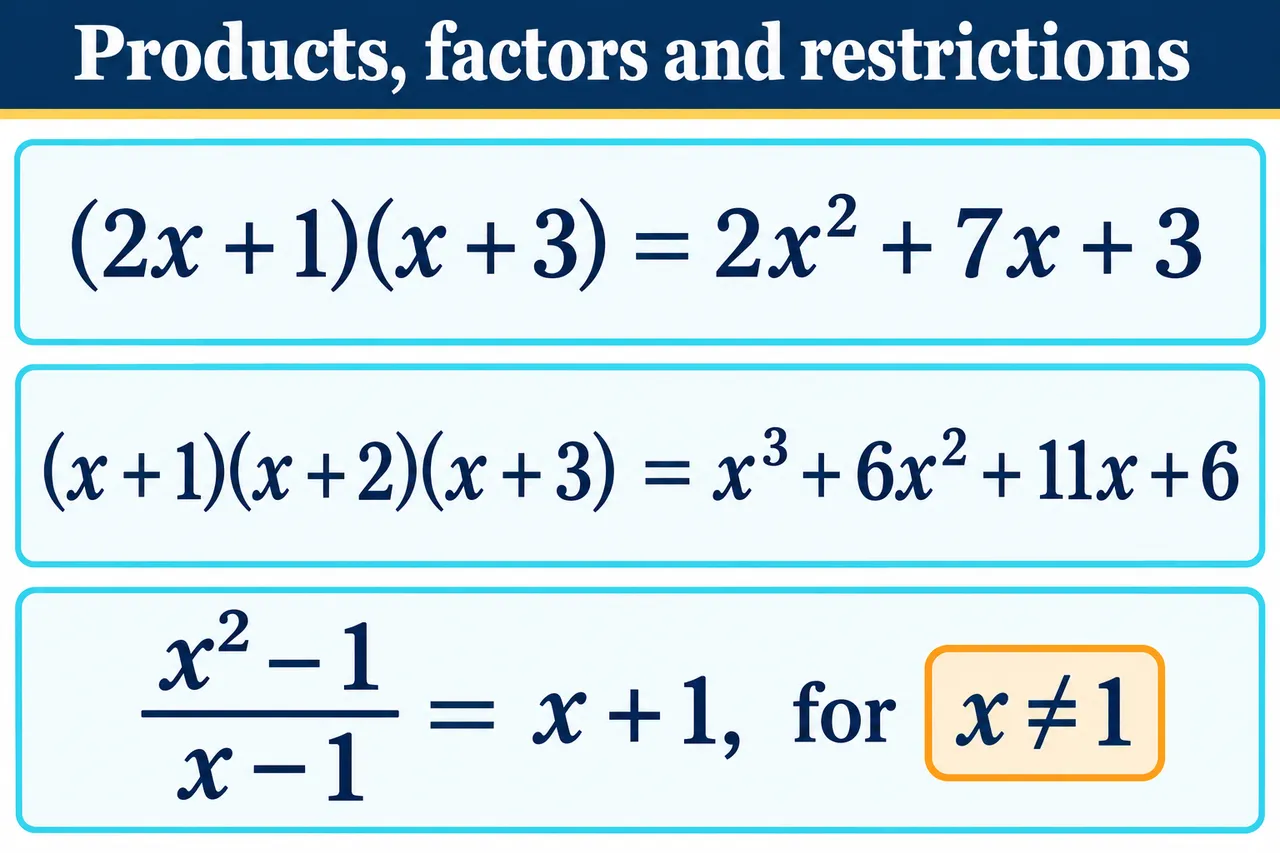
Original myAudience AI-generated mathematics teaching illustration; labels and relationships checked by the authoring agent. Independent integration review pending. · Original project artwork; no exam-board figures or textbook illustrations reused.
Simplify rational expressions while keeping restrictions
Factor the numerator and denominator before cancelling. Cancellation removes a common nonzero factor of an entire product, not a single term from a sum. The expression(x+2)/x does not simplify by deleting x from the numerator.
Domain restrictions survive simplification. In (x²−1)/(x−1), factorisation gives(x−1)(x+1)/(x−1). Cancelling shows equality to x+1 only for x≠1. The simpler expression by itself is defined at 1, but the original is not.
Adding algebraic fractions requires a common denominator just as numerical fractions do. For 1/x+1/(x+1), the common denominator is x(x+1), with both x≠0 and x≠−1. Combine the rewritten numerators without discarding those conditions.
Worked example: Simplify (x²−1)/(x−1) and state the restriction.
Use x²−1=(x−1)(x+1).
Cancel the shared factor only when x−1≠0.
Answer: x+1, with x≠1.
Check your understanding: Simplify 1/x+1/(x+1).
Answer: (2x+1)/(x(x+1)), with x≠0, −1.
Why: The rewritten numerator is(x+1)+x, while the original denominator restrictions remain.