Reverse and combine function rules
By UK GCSE Mathematics · independent study · myAudience
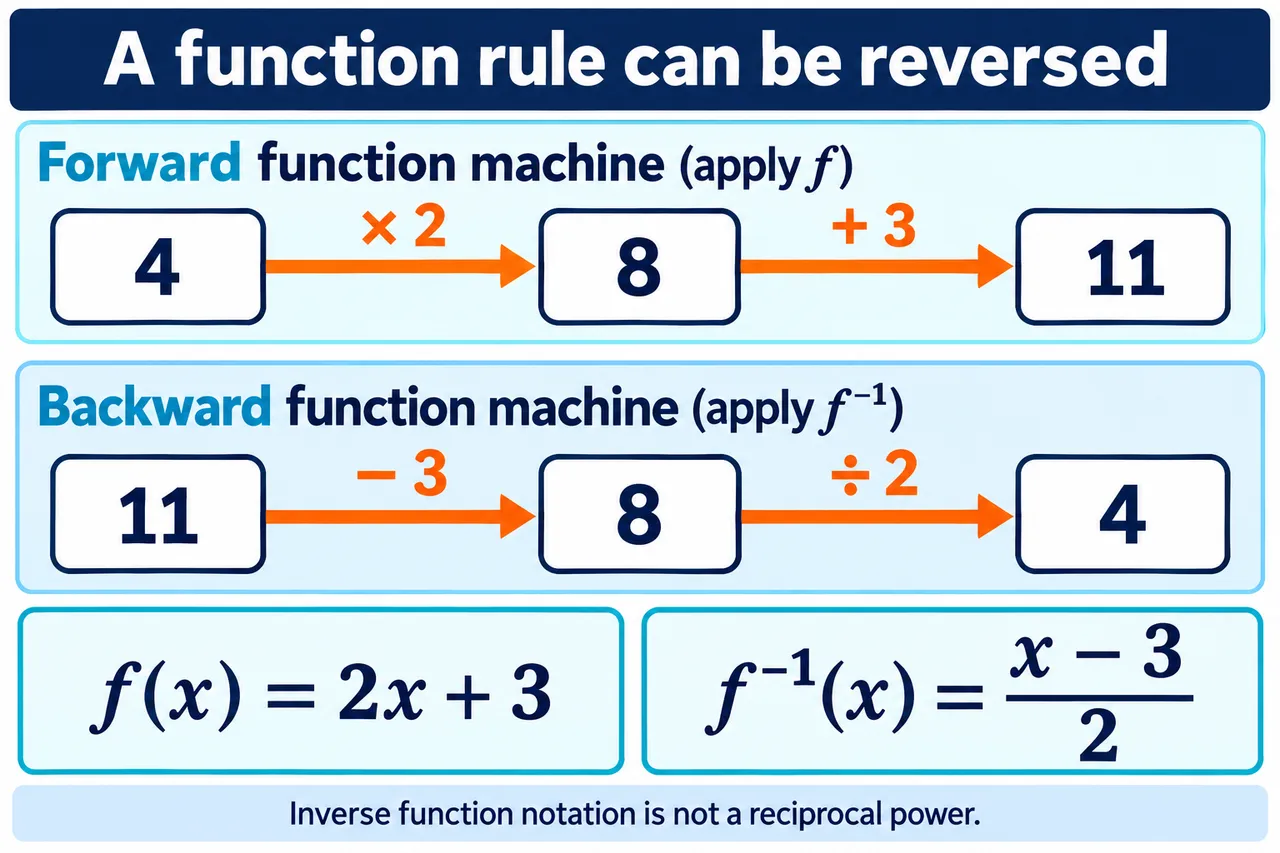
Original myAudience AI-generated mathematics teaching illustration; labels and relationships checked by the authoring agent. Independent integration review pending. · Original project artwork; no exam-board figures or textbook illustrations reused.
Reverse and combine function rules
For f(x)=2x+3, reverse the operations in reverse order: subtract 3, then divide by 2. The inverse is f⁻¹(x)=(x−3)/2. The superscript−1 here names an inverse function, not a reciprocal power.
A composite function applies one entire rule after another. With g(x)=x², g(f(x))=(2x+3)², whereas f(g(x))=2x²+3. Order usually matters. The inner function acts first, even though its name is written nearer the input.
An inverse must give a unique input from each allowed output. Squaring on all real inputs is not one-to-one, so its inverse cannot be a single-valued function without a domain restriction. On nonnegative inputs, the inverse of squaring is the nonnegative square-root function.
Worked example: Find f⁻¹(11) for f(x)=2x+3.
Undo the addition: 11−3=8.
Undo the multiplication: 8/2=4.
Answer: 4.
Check your understanding: For g(x)=x², what are g(f(1)) and f(g(1))?
Answer: 25 and 5.
Why: f(1)=5 then g gives 25; g(1)=1 then f gives 5, so order changes the result.