Choosing a system and tracking energy
By UK GCSE Physics · independent study · myAudience
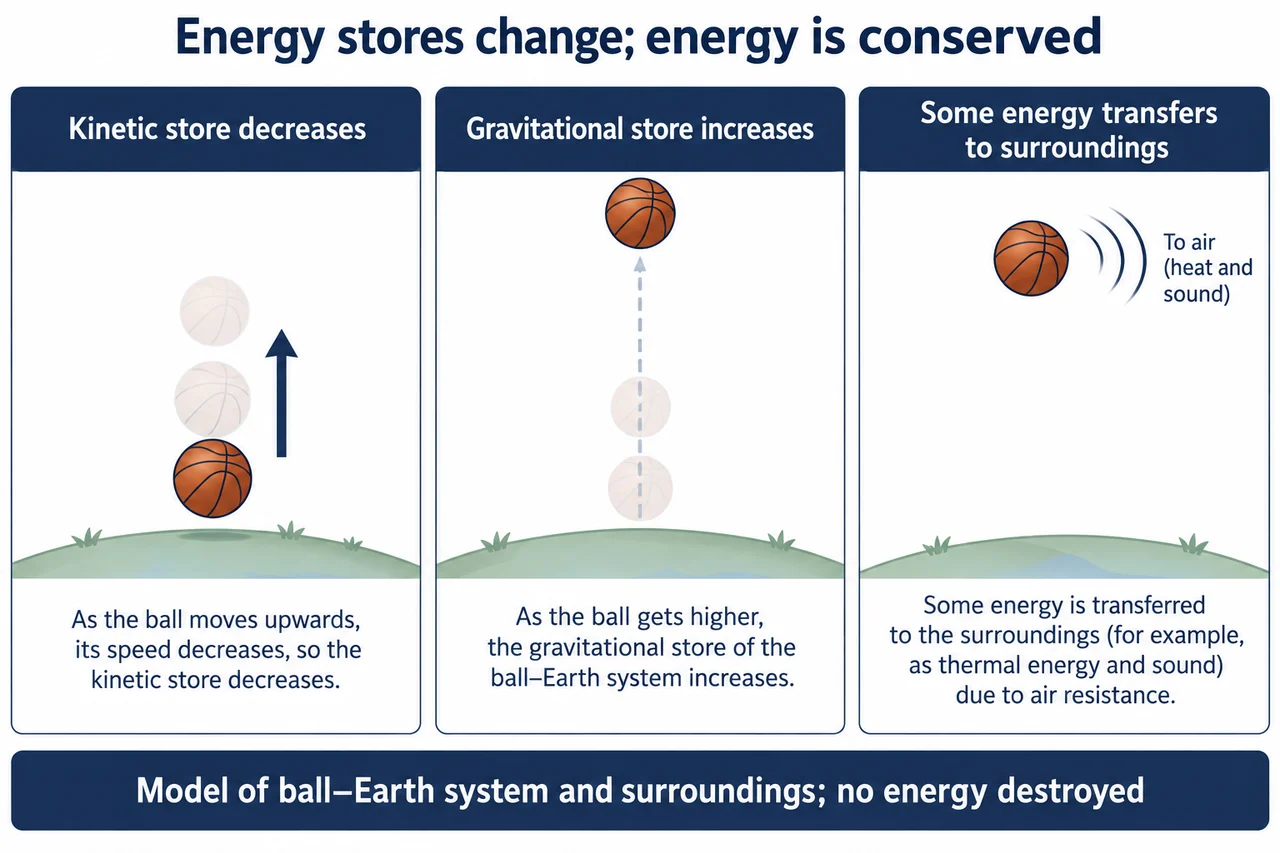
Image: illustration, not a documentary photograph. Original teaching model created for myAudience. · Original generated teaching illustration; no source textbook artwork reproduced.
Choosing a system and tracking energy
A system is the object or group of objects we choose to study. The choice matters: a falling ball alone exchanges energy with Earth and the surrounding air, while a ball–Earth system includes the gravitational interaction. Decide what is inside the boundary before describing a transfer across it.
Energy can be stored kinetically, thermally, chemically, elastically, gravitationally, magnetically, electrically or in nuclei. Heating, electrical work, mechanical work and radiation describe transfer pathways rather than extra stores. Saying light travels from a lamp describes a transfer; it does not establish a permanent light store inside the lamp.
As a thrown ball rises, its kinetic store decreases while the gravitational store of the ball–Earth system increases. Air resistance transfers some energy to thermal stores in the surroundings. A vehicle braking similarly transfers energy from its kinetic store into brakes, tyres and surroundings; energy has not vanished because the vehicle stops.
A kettle transfers energy electrically into water and its surroundings. A moving object hitting a barrier can increase thermal stores, deformation and sound transfer. Quantities should be drawn on a common scale when comparing before and after: a small final arrow must represent less energy than a large one, not merely look decorative.
Worked example: A system receives 120 J; 80 J increases the intended thermal store and the rest transfers to the surroundings. Find the remainder.
The transferred energy must be accounted for.
Subtract the intended increase from the total: 120−80.
Describe the 40 J as energy in other stores, not destroyed energy.
Answer: 40 J transferred to the surroundings
Check your understanding: Is heating a store of energy?
Answer: No; it is a transfer pathway.
Why: A thermal store describes energy associated with a system; heating describes transfer caused by a temperature difference.