Calculating kinetic, gravitational and elastic changes
By UK GCSE Physics · independent study · myAudience
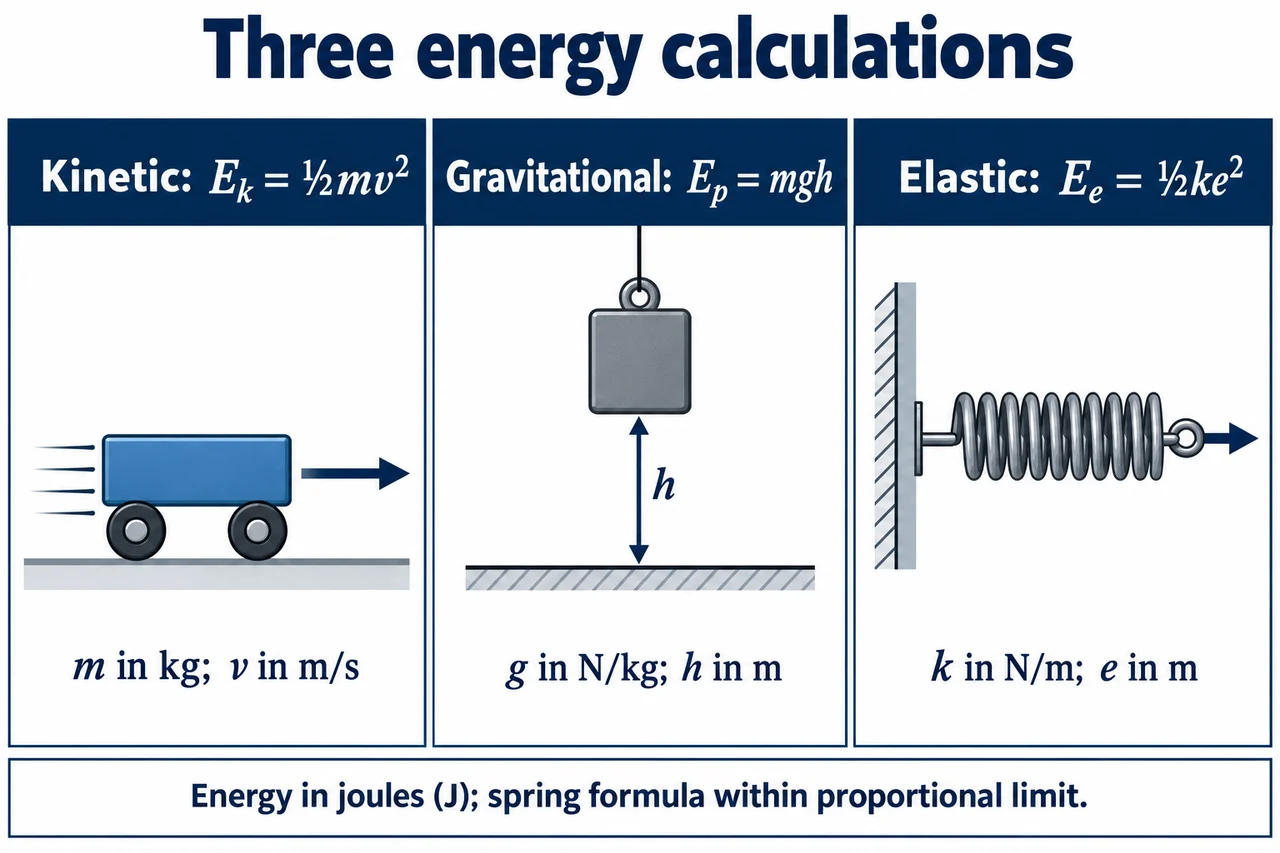
Image: illustration, not a documentary photograph. Original teaching model created for myAudience. · Original generated teaching illustration; no source textbook artwork reproduced.
Calculating kinetic, gravitational and elastic changes
For an object of mass m moving at speed v, kinetic energy is Eₖ=½mv². Use kilograms and metres per second to obtain joules. Doubling speed quadruples kinetic energy at the same mass; the squared quantity cannot be replaced by a simple factor of two.
Raising an object through height h increases gravitational potential energy by Eₚ=mgh in a near-uniform field. Use the gravitational field strength supplied in the question. Height is the change relative to the chosen reference, not necessarily the entire building height or the height above sea level.
For a spring within its proportional range, elastic energy is Eₑ=½ke², where k is in newtons per metre and extension e is in metres. Extension means change from the unstretched length. The equation is not a reliable prediction once the spring is stretched beyond its limit of proportionality.
Check units before calculating. A 10 cm extension is 0.10 m: squaring 10 instead of 0.10 creates a factor-of 10,000 error. The value of a stored energy can be compared with a transfer only when the system and reference are consistently defined.
Worked example: A 2 kg object moves at 4 m/s. Calculate its kinetic energy.
Square the speed: 4²=16 m²/s².
Substitute Eₖ=½×2×16.
Keep the result in joules.
Answer: 16 J
Check your understanding: A 200 N/m spring extends 0.10 m within its proportional range. What is stored?
Answer: 1 J.
Why: ½×200×0.10²=1. Extension must be expressed in metres before squaring.