Specific heat capacity and a measured temperature rise
By UK GCSE Physics · independent study · myAudience
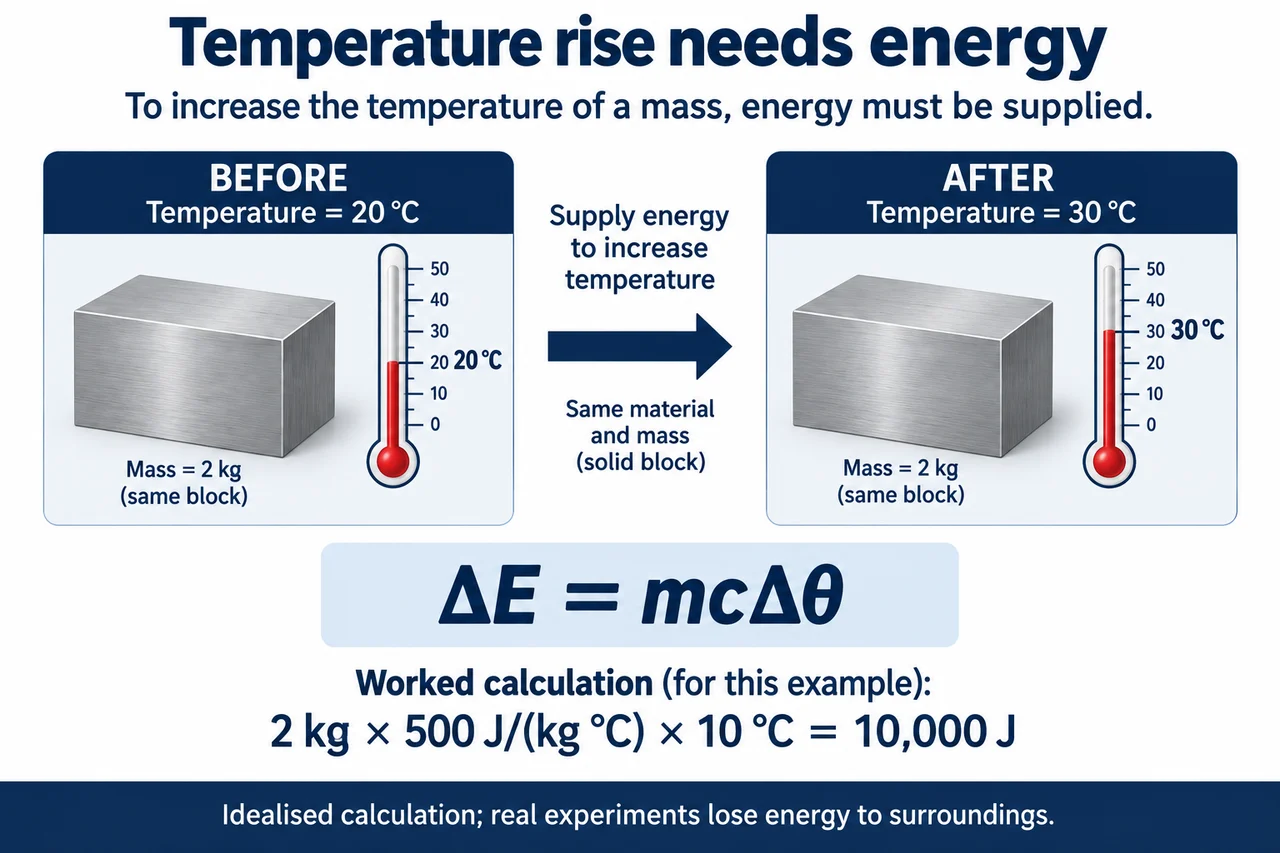
Image: illustration, not a documentary photograph. Original teaching model created for myAudience. · Original generated teaching illustration; no source textbook artwork reproduced.
Specific heat capacity and a measured temperature rise
Temperature and thermal energy are different quantities. A larger mass of the same material can require more energy for the same temperature rise. Specific heat capacity c states the energy per kilogram needed for a one-degree Celsius rise, under the conditions where that description applies.
The model ΔE=mcΔθ links transferred thermal energy, mass and temperature change. Use Δθ=final temperature−initial temperature, not simply the final thermometer reading. A material with a larger c requires more energy for the same mass and rise. This equation does not describe an entire phase change at constant temperature.
In the practical study, a supervised investigation connects known energy transfer with mass and temperature measurements to estimate specific heat capacity. An electrically heated block can use measured power and heating time to estimate input energy, but not every joule reaches the block. Insulation and suitable contact between heater, block and thermometer reduce avoidable errors.
A good evaluation distinguishes random variation from systematic energy loss. Repeated readings can reveal variation, but repeating a poorly insulated setup does not remove energy transferred to surroundings. Real apparatus requires a teacher-approved method and safety controls; reading this model does not record laboratory completion.
Worked example: A 2 kg sample has c=500 J/(kg°C) and warms from 20 °C to 30 °C. Calculate its thermal-store increase.
Temperature rise=30−20=10 °C.
Use ΔE=2×500×10.
The model assumes the given c applies across this interval.
Answer: 10,000 J
Check your understanding: If heater input is used without accounting for heat loss, what may happen to estimated c?
Answer: It may be overestimated.
Why: Input energy can exceed the energy producing the measured temperature rise, making E/(mΔθ) too large.