Power: how fast energy is transferred
By UK GCSE Physics · independent study · myAudience
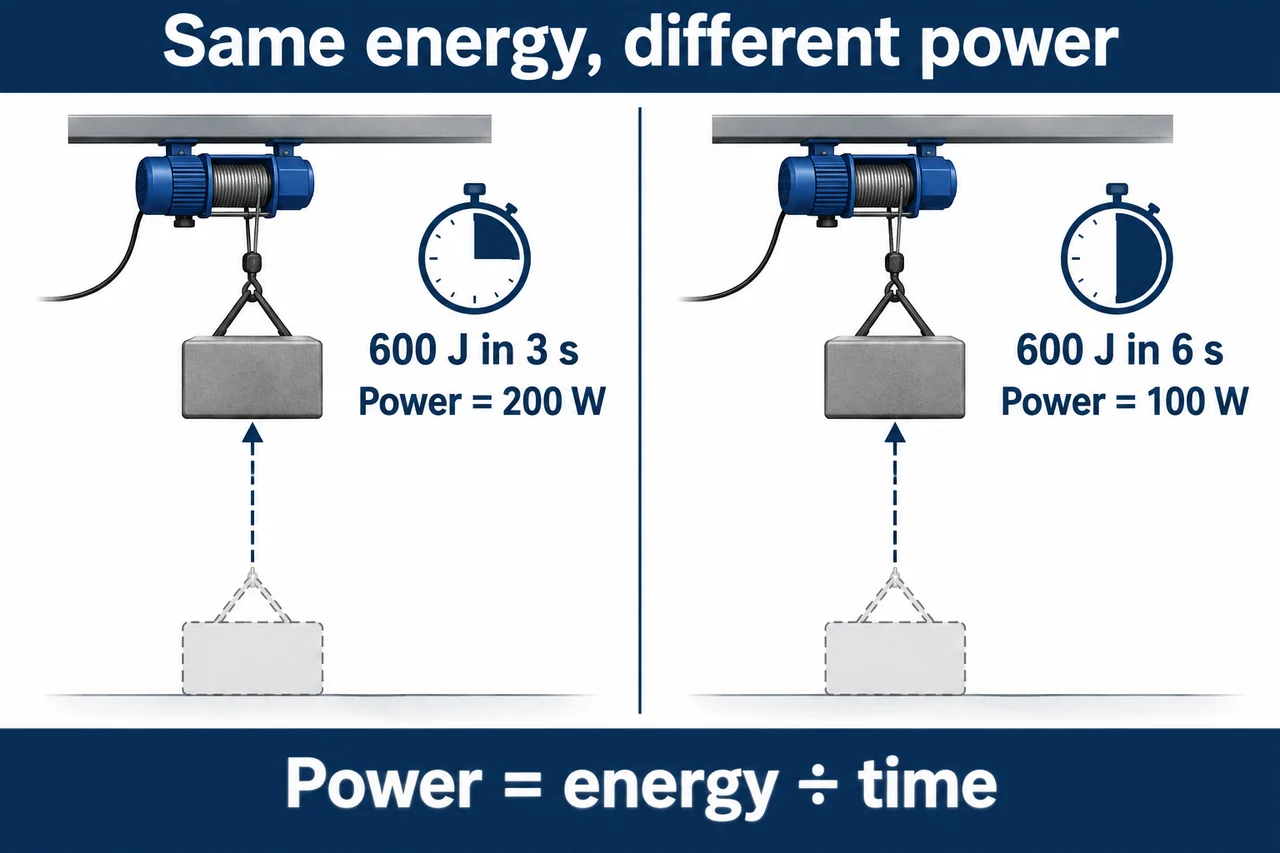
Image: illustration, not a documentary photograph. Original teaching model created for myAudience. · Original generated teaching illustration; no source textbook artwork reproduced.
Power: how fast energy is transferred
Power is energy transferred per unit time, P=E/t. It can also be expressed as work done per time, P=W/t. One watt means one joule per second. The unit W for watt and the symbol W sometimes used for work mean different things; context resolves the notation.
Two motors can perform the same lifting work but have different powers. The faster motor transfers the required energy in less time. A high power does not mean an appliance necessarily uses more energy over every period: both power and running time determine total transfer.
Rearrange the relationship when needed: E=Pt and t=E/P. Seconds are needed with watts and joules. A minute is 60 seconds, so a calculation that inserts minutes without conversion produces a numerical error. For heating or lifting, also consider how much of the input becomes the intended transfer.
Worked example: A motor transfers 600 J in 3 s. Find its power and compare a motor doing the same work in 6 s.
First motor: P=600/3=200 W.
Second motor: P=600/6=100 W.
Both transfer 600 J, but the first transfers it twice as fast.
Answer: 200 W versus 100 W
Check your understanding: Does a 200 W device running for 10 s transfer the same energy as 100 W running for 20 s?
Answer: Yes: both transfer 2000 J.
Why: Energy depends on power multiplied by time, not on power alone.