Conservation, dissipation and reducing unwanted transfers
By UK GCSE Physics · independent study · myAudience
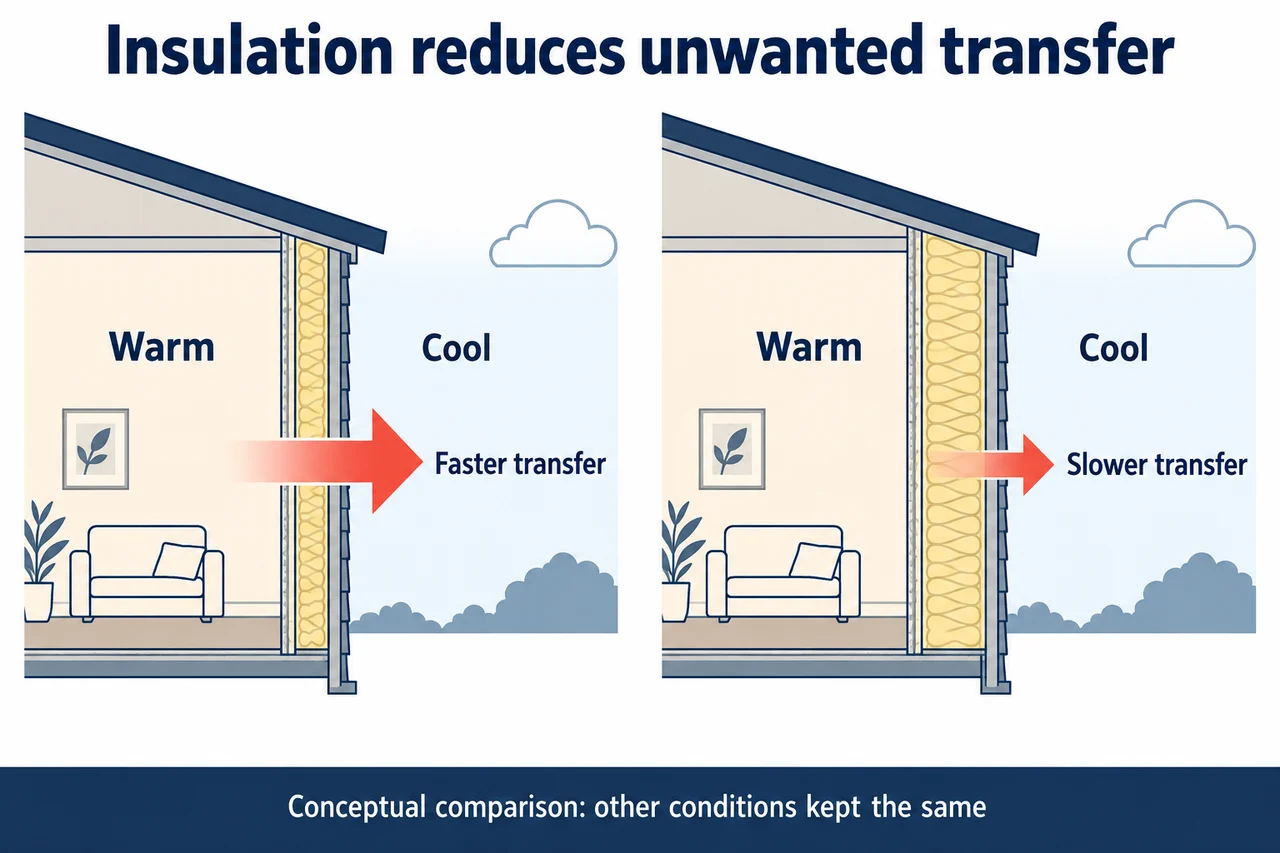
Image: illustration, not a documentary photograph. Original teaching model created for myAudience. · Original generated teaching illustration; no source textbook artwork reproduced.
Conservation, dissipation and reducing unwanted transfers
Energy cannot be created or destroyed in an ordinary system change. In an appropriately closed energy-accounting system, the total stays constant although its distribution changes. If energy crosses the chosen boundary, the receiving surroundings must be included when completing the account.
Dissipation means energy becomes spread into less useful stores, often warming surroundings. It does not mean it ceases to exist. Lubrication can reduce unwanted transfer associated with friction; thermal insulation can reduce transfer driven by a temperature difference.
For comparable walls, lower thermal conductivity and greater thickness generally reduce the rate of conduction. The comparison assumes other factors, such as wall area and temperature difference, are appropriately controlled. A complete building also has windows, ventilation and other transfer pathways, so one wall property cannot predict every cooling rate.
This practical study investigates thermal insulation. A fair supervised comparison can vary insulating material or thickness while controlling the container, starting conditions and timing. Cooling curves should be compared over equivalent conditions; a graph is evidence from a setup, not proof that one material is best in every building. Reading does not complete this practical.
Worked example: A moving object has 100 J initially; after slowing it has 25 J kinetic energy. Account for the 75 J difference.
Initial minus final kinetic store=100−25.
Look for transfer into braking components and surroundings.
Include those thermal increases in the broader energy account.
Answer: 75 J transferred into other stores; none destroyed
Check your understanding: Why can two walls of different thickness not fairly compare material alone?
Answer: Thickness also changes the rate of transfer.
Why: A fair material comparison controls thickness or separately accounts for it.