Efficiency and useful output
By UK GCSE Physics · independent study · myAudience
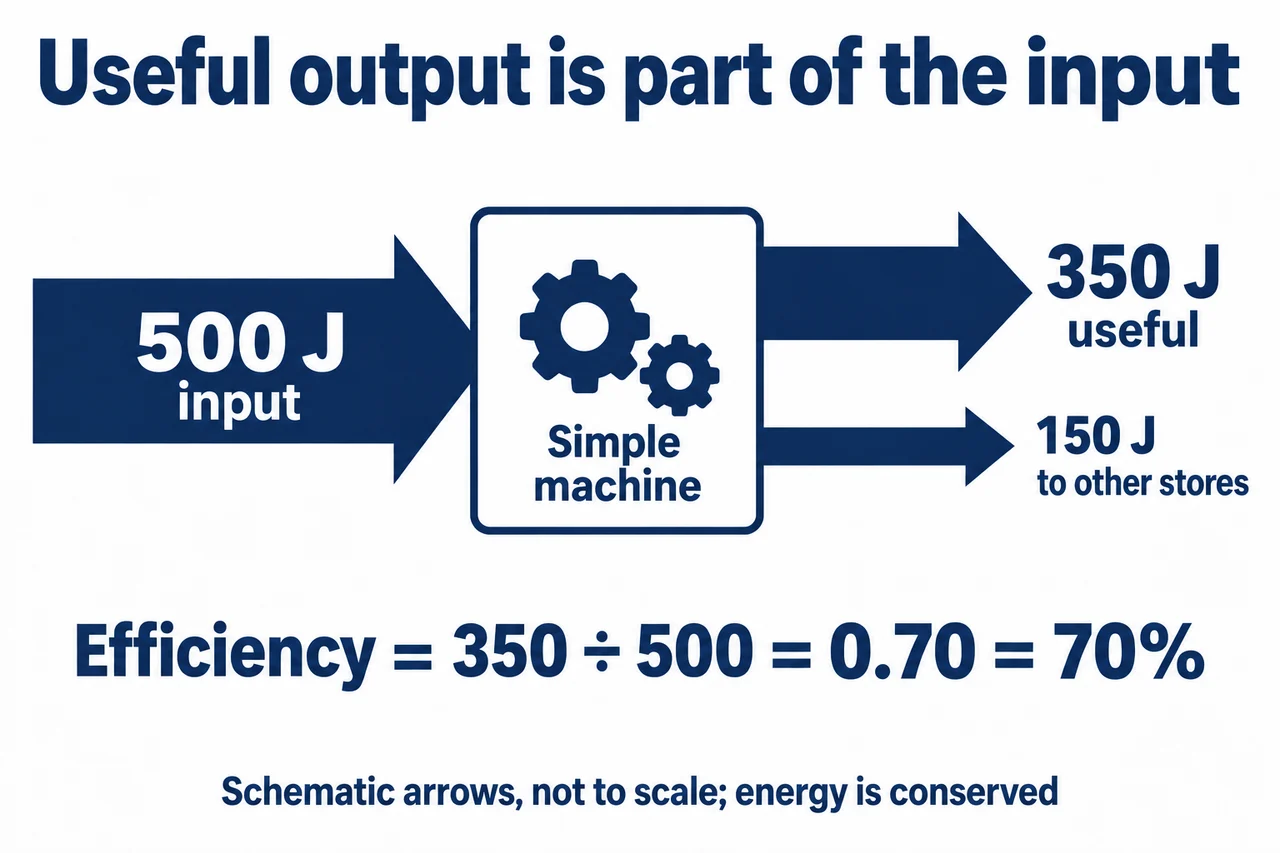
Image: illustration, not a documentary photograph. Original teaching model created for myAudience. · Original generated teaching illustration; no source textbook artwork reproduced.
Efficiency and useful output
Efficiency compares useful output with total input. It can be calculated as useful energy/total energy, or useful power/total power when measured on a consistent basis. Multiply the fraction by 100 for a percentage. Define what useful means for the actual task before choosing the numerator.
An efficiency of 0.80 means 80% of input reaches the chosen useful output. The remaining 20% is not destroyed; it is transferred in other ways. A measured efficiency above 100% usually indicates inconsistent accounting, units or measurements, not a device creating energy.
Higher-tier explanations of improvement connect a change with the intended transfer: suitable lubrication reduces frictional heating in machinery, while insulation reduces unwanted heating of surroundings. A change can have costs or trade-offs, so more efficient does not automatically mean more economical or more suitable for every job.
Worked example: A device receives 500 J and provides 350 J useful output. Calculate efficiency and other transfers.
Efficiency=350/500=0.70.
Percentage=0.70×100=70%.
Other transfers=500−350=150 J.
Answer: 70% efficient; 150 J transferred in other ways
Check your understanding: Can efficiency be calculated with 350 J divided by 500 W?
Answer: No.
Why: Input and output must be comparable quantities; mixing energy and power gives the wrong dimensions.