Comparing energy resources with evidence
By UK GCSE Physics · independent study · myAudience
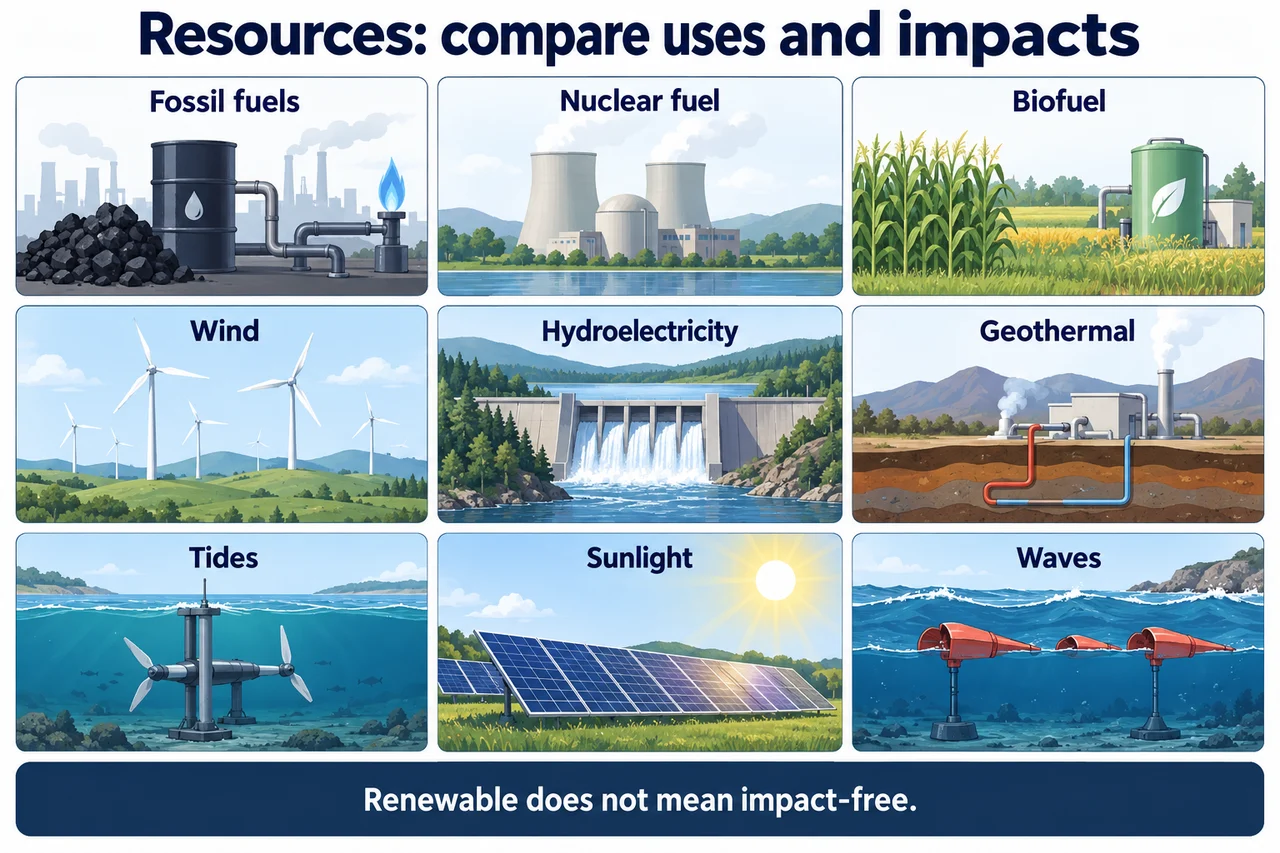
Image: illustration, not a documentary photograph. Original teaching model created for myAudience. · Original generated teaching illustration; no source textbook artwork reproduced.
Comparing energy resources with evidence
Coal, oil and natural gas are fossil resources replenished far too slowly to count as renewable on human-use timescales. Nuclear fuel is also finite. Wind, sunlight, tides, waves, hydroelectricity and geothermal resources are renewable in the relevant sense; biofuels can be replenished, but their land use and growing conditions matter.
Resources meet different needs in transport, heating and electricity generation. Oil-derived fuels are widely useful for transport, while wind produces electricity rather than a liquid fuel. Electricity can transfer energy to vehicles and heating systems, but that alone does not identify how the electricity was generated.
Reliability has several meanings. Solar output varies with sunlight and wind output with weather; tidal timing is predictable but output still varies. Reservoir hydro can be controllable when water is available. Fuelled stations can schedule output, but maintenance, fuel supply and environmental limits also affect availability.
Environmental comparisons include greenhouse-gas emissions, air pollution, extraction, land use, habitat changes and waste. Renewable does not mean impact-free, and nuclear operation differs from fossil combustion while raising its own waste and construction questions. Scientific evidence informs a choice; economic, political and social constraints also influence decisions. Avoid invented current percentages when no dated dataset is provided.
Worked example: A hypothetical district uses 40 units of wind electricity and 60 units from gas. Calculate the renewable percentage of this stated mix.
Total=40+60=100 units.
Wind is the stated renewable portion.
40/100×100=40%; this is fictional data, not a national statistic.
Answer: 40% for this hypothetical mix
Check your understanding: Does predictable tidal timing mean constant electrical output?
Answer: No.
Why: A predictable cycle can still contain periods of greater and lower output.