Locate points in all four quadrants
By UK GCSE Mathematics · independent study · myAudience
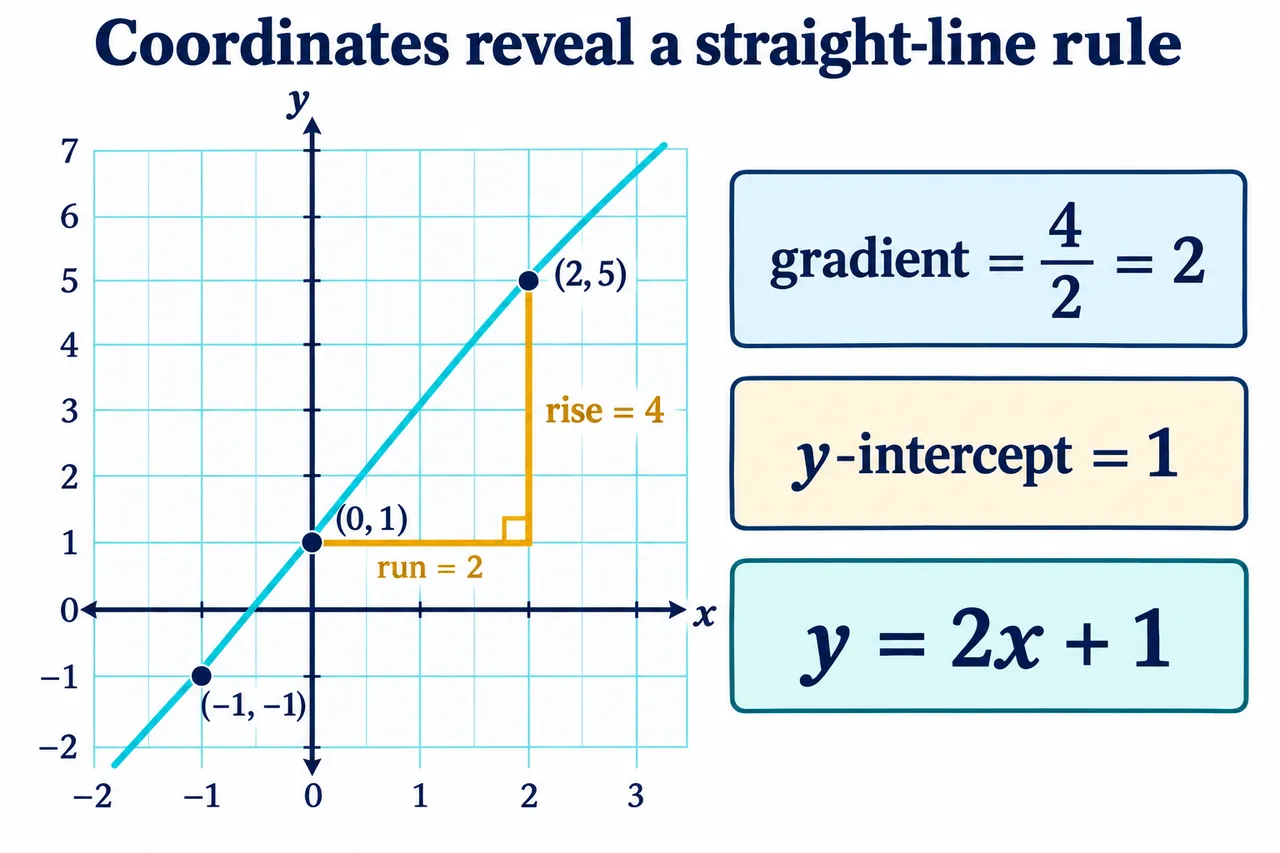
Original myAudience mathematics teaching illustration; labels, relationships and lesson calculations independently checked. · Original project artwork; no exam-board figures or textbook illustrations reused.
Locate points in all four quadrants
A coordinate pair gives a horizontal position first and a vertical position second. For (−1, −1), move one unit left from the origin and one unit down. The origin is (0, 0); a point on an axis has one coordinate equal to zero and is not inside a quadrant.
The four quadrants are distinguished by signs: (+,+), (−,+), (−,−), (+,−), moving anticlockwise from the upper right. Read the scale before plotting. A square on paper need not represent one unit, and the two axes can use different numerical scales.
Coordinates connect pictures to calculations. A table of input x and output y becomes a collection of plotted points. Check a point against the rule that generated it rather than trusting its appearance on a grid.
Worked example: Plot the point (−2, 3).
Start at the origin.
Move two x-units left, then three y-units up.
Mark the intersection, using the actual axis scales.
Answer: The point lies in the upper-left quadrant.
Check your understanding: Which axis contains (0, −4)?
Answer: The y-axis.
Why: Its horizontal coordinate is zero.