Build a line from a gradient and an intercept
By UK GCSE Mathematics · independent study · myAudience
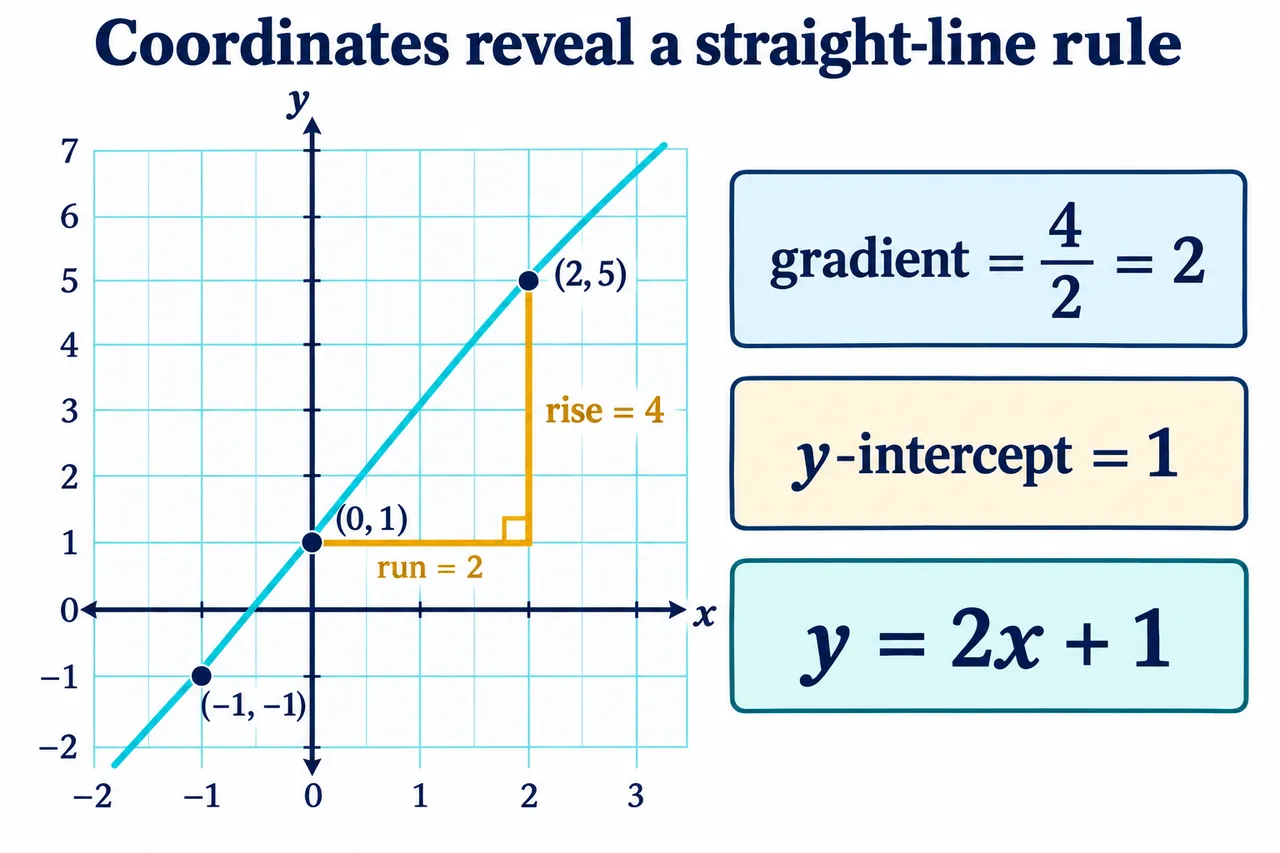
Original myAudience mathematics teaching illustration; labels, relationships and lesson calculations independently checked. · Original project artwork; no exam-board figures or textbook illustrations reused.
Build a line from a gradient and an intercept
A straight line of the form y = mx + c has gradient m and y-intercept c. The intercept is the output when x = 0. A positive gradient means the output increases as x increases; a negative gradient means it decreases.
Two distinct points determine a line. Calculate the gradient as change in y divided by change in x, then substitute one point to find c. A vertical line has an equation such as x = 3 and cannot be written with a finite gradient in this form.
Lines with the same gradient are parallel when their intercepts differ. Equal gradient and equal intercept describe the same line. Always compare gradients after rearranging equations into a consistent form.
Worked example: Find the line through (0, 1) and (2, 5).
The rise is 5 − 1 = 4 and the run is 2 − 0 = 2.
The gradient is 4/2 = 2.
The point with x = 0 gives c = 1.
Answer: y = 2x + 1.
Check your understanding: Is y = 2x − 3 parallel to this line?
Answer: Yes.
Why: Both gradients are 2, but the intercepts differ.