Interpret a gradient as a rate of change
By UK GCSE Mathematics · independent study · myAudience
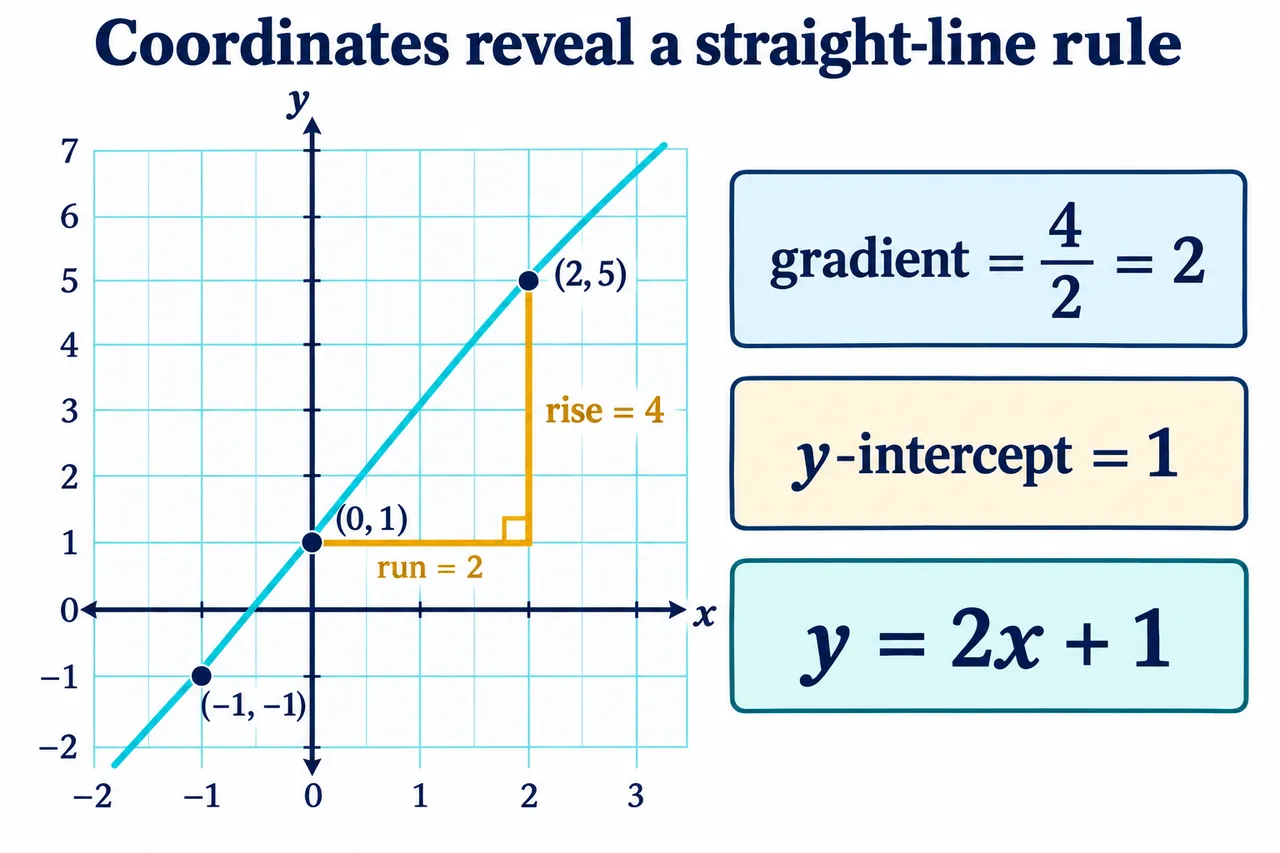
Original myAudience mathematics teaching illustration; labels, relationships and lesson calculations independently checked. · Original project artwork; no exam-board figures or textbook illustrations reused.
Interpret a gradient as a rate of change
Gradient compares the change in the dependent quantity with the change in the input. On y = 2x + 1, increasing x by one increases y by two. A gradient triangle can use any two distinct points on a straight line; using a larger triangle often reduces graphical reading error.
Axis units determine gradient units. If the vertical axis is cost in pounds and the horizontal axis is hours, the gradient is pounds per hour. The intercept can represent a fixed charge, but only if that interpretation fits the model and zero input is meaningful.
Graphical readings have limited precision. Use the printed scale, show which two points were read and avoid claiming an exact rate from a rough sketch. An equation provides an algebraic rate without that plotting uncertainty.
Worked example: A hire cost is C = 4h + 7. Interpret both constants.
Compare with y = mx + c.
The coefficient of h is the change in pounds per additional hour.
Set h = 0 to identify the fixed charge.
Answer: £4 per hour and a £7 fixed charge.
Check your understanding: For points (1, 4) and (4, 10), what is the gradient?
Answer: 2.
Why: The rise is 6 and run is 3, so 6/3 = 2.