Read roots, intercepts and turning points
By UK GCSE Mathematics · independent study · myAudience
Original myAudience mathematics teaching illustration; labels, relationships and lesson calculations independently checked. · Original project artwork; no exam-board figures or textbook illustrations reused.
Read roots, intercepts and turning points
A root is an input where the output is zero. On a graph it is an x-axis intersection. The y-intercept is found by setting x to zero. These are different questions: a quadratic can have two roots, one repeated root or no real roots, while its y-intercept still exists.
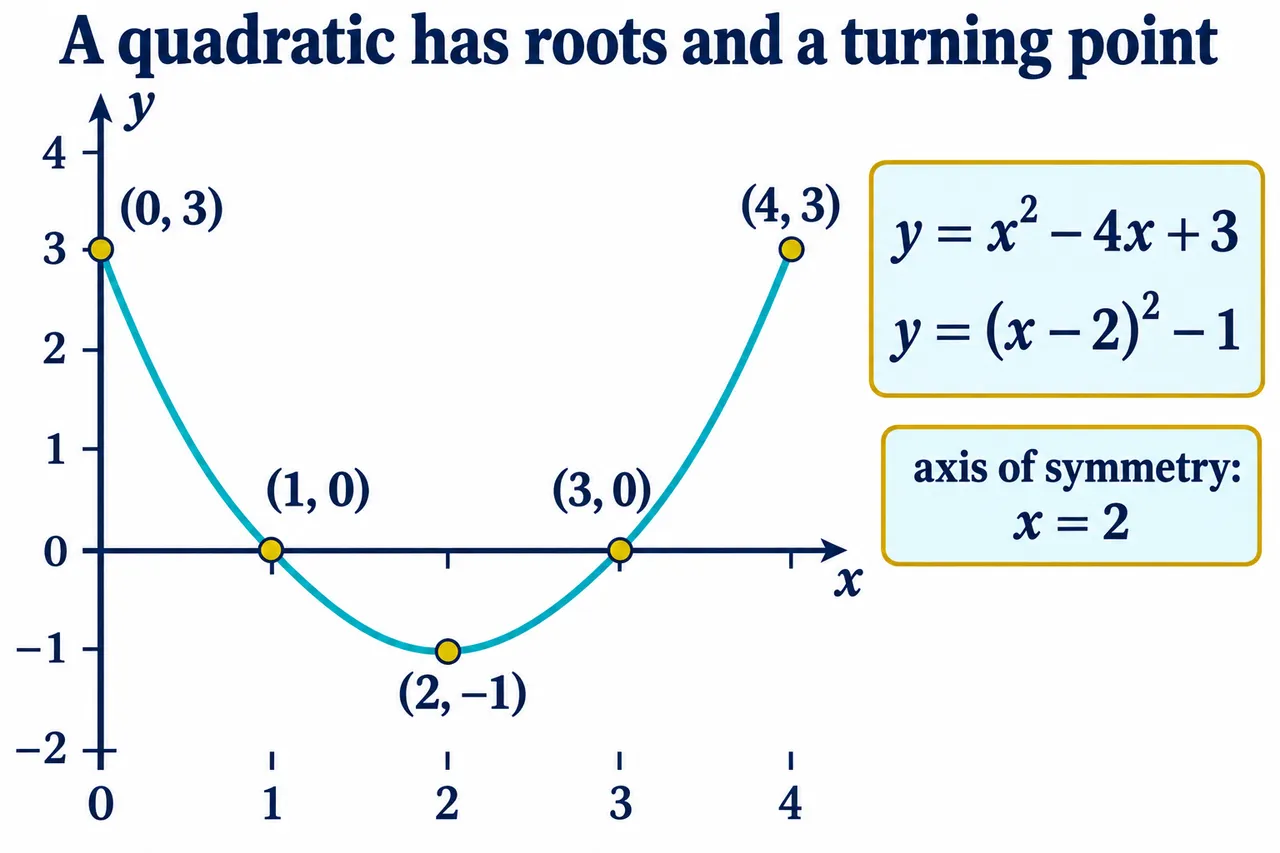
A quadratic graph is a parabola. Its turning point is a minimum when the coefficient of x² is positive and a maximum when it is negative. For the illustrated graph, the roots are 1 and 3, the y-intercept is 3 and the minimum is (2, −1).
Factorisation can identify roots exactly. If y = (x − 1)(x − 3), setting y = 0 means at least one factor must be zero. Reading the same roots from a graph provides a useful check, with precision limited by the scale.
Worked example: Find the roots and y-intercept of y = (x − 1)(x − 3).
Set the product equal to zero.
Solve x − 1 = 0 or x − 3 = 0.
Set x = 0 for the y-intercept.
Answer: Roots 1 and 3; y-intercept 3.
Check your understanding: Is (2, −1) a root of this graph?
Answer: No.
Why: It is the turning point; its output is −1, not zero.