Recognise linear, quadratic and cubic shapes
By UK GCSE Mathematics · independent study · myAudience
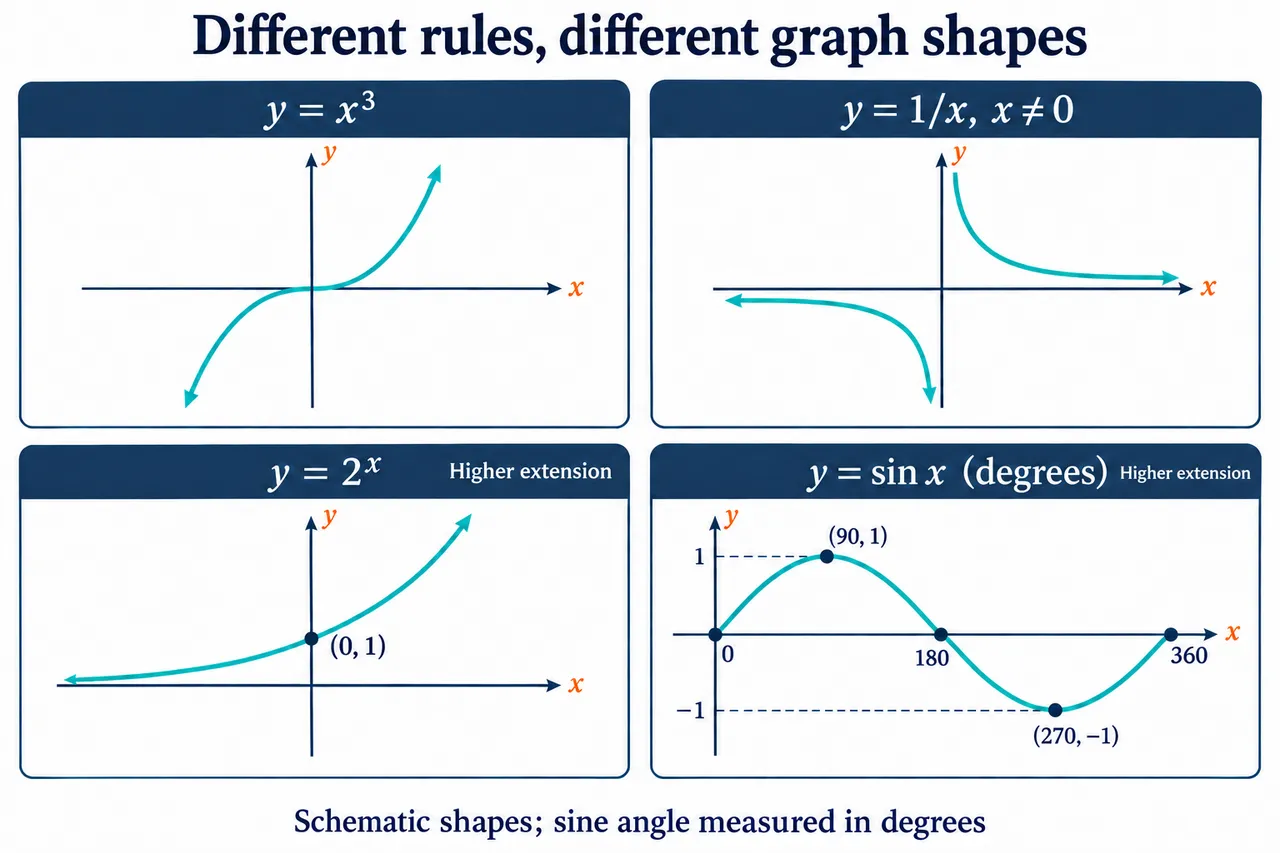
Original myAudience mathematics teaching illustration; labels, relationships and lesson calculations independently checked. · Original project artwork; no exam-board figures or textbook illustrations reused.
Recognise linear, quadratic and cubic shapes
A rule determines the shape and important features of its graph. A nonvertical straight line has constant gradient. The graph y = x² is a U-shaped parabola through the origin, with nonnegative outputs. The graph y = x³ passes through the origin and takes negative outputs for negative inputs.
Tables help locate points, but a sketch also needs the behaviour between them. For y = x³, inputs −2, −1, 0, 1, 2 give outputs −8, −1, 0, 1, 8. The curve increases throughout; its flattening near the origin is not a maximum or minimum.
Symmetry helps check a drawing. The graph of x² is reflected onto itself in the y-axis, whereas x³ has rotational symmetry about the origin. A graph-family sketch communicates these features without pretending to provide exact readings everywhere.
Worked example: Calculate points for y = x³ at x = −2, 0, 2.
Cube each signed input.
An odd number of negative factors gives a negative result.
Answer: (−2, −8), (0, 0), (2, 8).
Check your understanding: Can y = x² have output −4 for a real input?
Answer: No.
Why: The square of a real number is nonnegative.