Find a perpendicular line using reciprocal gradients
By UK GCSE Mathematics · independent study · myAudience
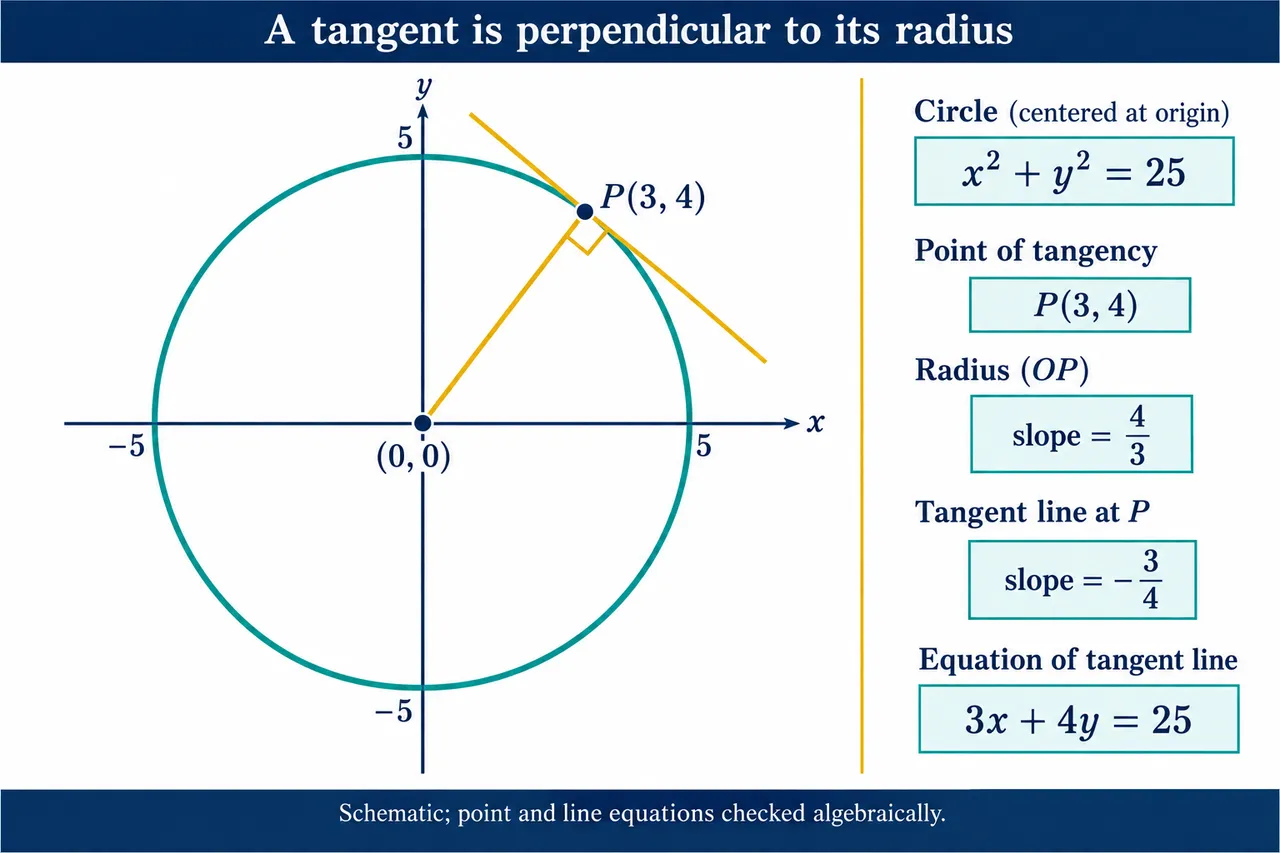
Original myAudience mathematics teaching illustration; labels, relationships and lesson calculations independently checked. · Original project artwork; no exam-board figures or textbook illustrations reused.
Find a perpendicular line using reciprocal gradients
For two nonvertical perpendicular lines with nonzero gradients m₁ and m₂, the product m₁m₂ is −1. The second gradient is therefore the negative reciprocal of the first. This rule assumes ordinary Cartesian coordinates with compatible axis units, not a visually stretched contextual chart.
Find the required gradient first, then use a point to determine the intercept. Horizontal and vertical lines are the special pair: their equations are y = constant and x = constant, so the finite-gradient product rule is not used for them.
Perpendicularity is stronger than simply having opposite gradient signs. Gradients 2 and −2 do not have product −1, whereas 2 and −1/2 do. Substitution checks whether the final line also passes through the required point.
Worked example: Find the line through (0, 3) perpendicular to y = 2x + 1.
The original gradient is 2.
Its negative reciprocal is −1/2.
The required line has y-intercept 3.
Answer: y = −x/2 + 3.
Check your understanding: What gradient is perpendicular to 4/3?
Answer: −3/4.
Why: Their product is −1.