Complete the square to locate a turning point
By UK GCSE Mathematics · independent study · myAudience
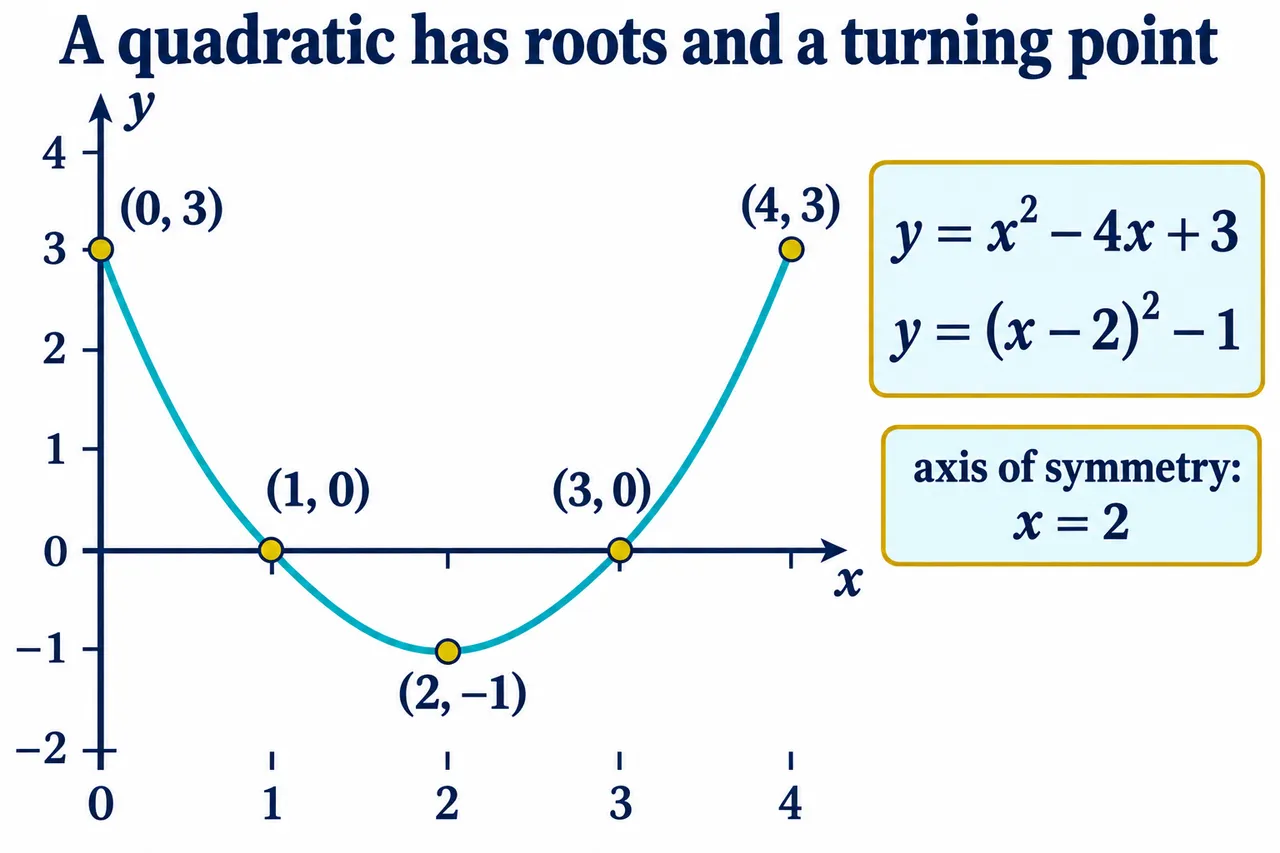
Original myAudience mathematics teaching illustration; labels, relationships and lesson calculations independently checked. · Original project artwork; no exam-board figures or textbook illustrations reused.
Complete the square to locate a turning point
Completing the square rewrites a quadratic without changing its values. Since (x − 2)² = x² − 4x + 4, the expression x² − 4x + 3 is (x − 2)² − 1. The square term makes the minimum visible.
A real square is nonnegative, so the smallest output here is −1, attained at x = 2. Thus the turning point is (2, −1). The form a(x − h)² + k gives turning point (h, k); the sign of a determines minimum or maximum.
The method also works with a non-unit leading coefficient, but factor that coefficient from the square and linear terms first. Check the rewrite by expanding. A missed compensation term changes every output and gives the wrong turning point.
Worked example: Complete the square for x² + 6x + 5.
Half the coefficient 6 to obtain 3.
(x + 3)² = x² + 6x + 9.
Subtract 4 to restore constant 5.
Answer: (x + 3)² − 4; minimum (−3, −4).
Check your understanding: What is the turning point of y = −2(x − 1)² + 7?
Answer: Maximum (1, 7).
Why: The squared term is at least zero and its coefficient is negative.