Estimate the gradient of a curve with a tangent
By UK GCSE Mathematics · independent study · myAudience
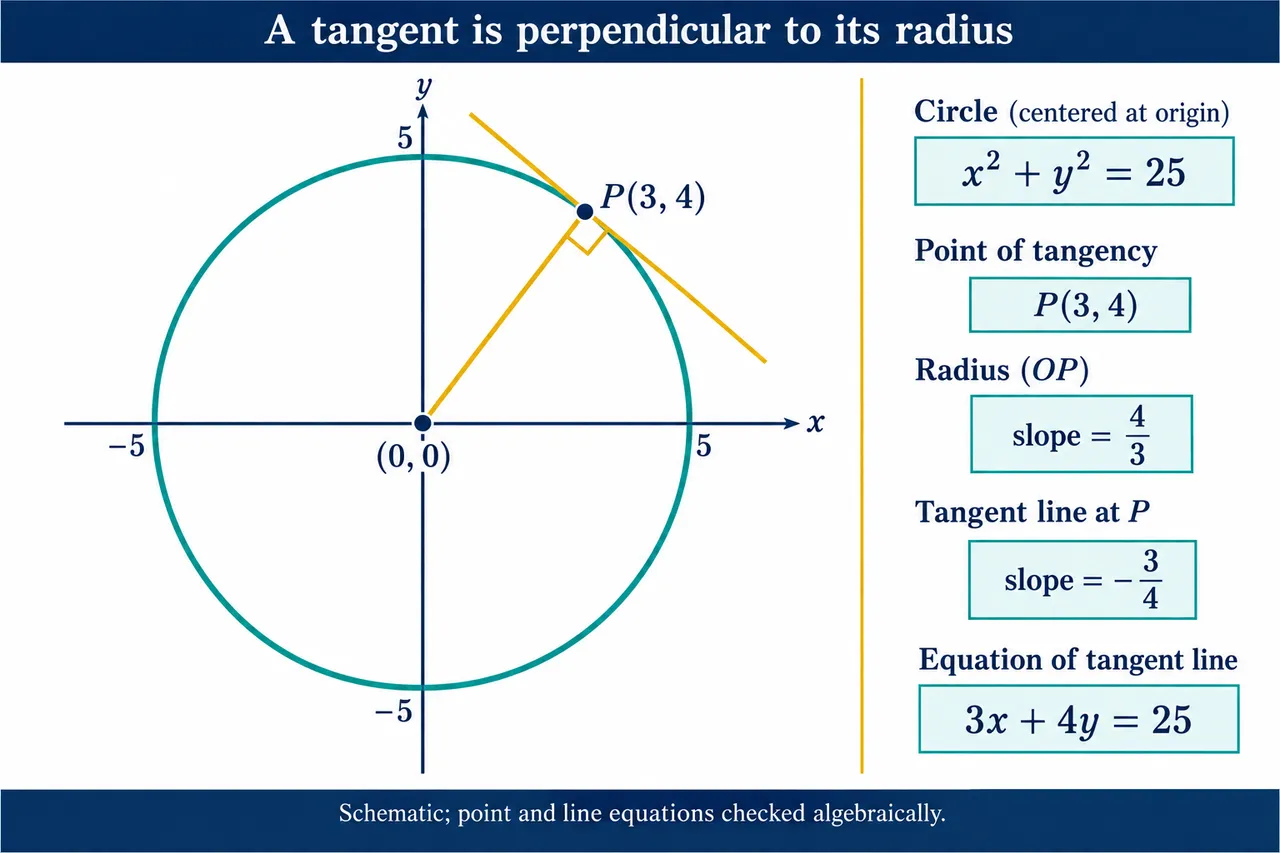
Original myAudience mathematics teaching illustration; labels, relationships and lesson calculations independently checked. · Original project artwork; no exam-board figures or textbook illustrations reused.
Estimate the gradient of a curve with a tangent
A curve does not generally have one gradient for its whole length. To estimate its gradient at a point, draw a tangent that follows the local direction there. Calculate rise over run using two well-separated points on that tangent, not two arbitrary points on the curve.
A secant joins two points on a curve and gives an average rate over their interval. A tangent gives a local graphical estimate. Confusing these can give the wrong interpretation when the rate changes.
Units still come from vertical change divided by horizontal change. On a distance-time graph, a tangent gradient estimates instantaneous speed. Accuracy depends on drawing and scale; this graphical method does not require differentiating a formula.
Worked example: A drawn tangent on a distance-time graph passes through (2 s, 5 m) and (6 s, 17 m). Estimate speed.
Calculate the distance change: 12 m.
Calculate the time change: 4 s.
Divide change in distance by change in time.
Answer: Approximately 3 m/s.
Check your understanding: Must both points used for the calculation lie on the original curve?
Answer: No; they lie on the drawn tangent.
Why: The tangent line supplies the local gradient estimate.