Use the equation of a circle centred at the origin
By UK GCSE Mathematics · independent study · myAudience
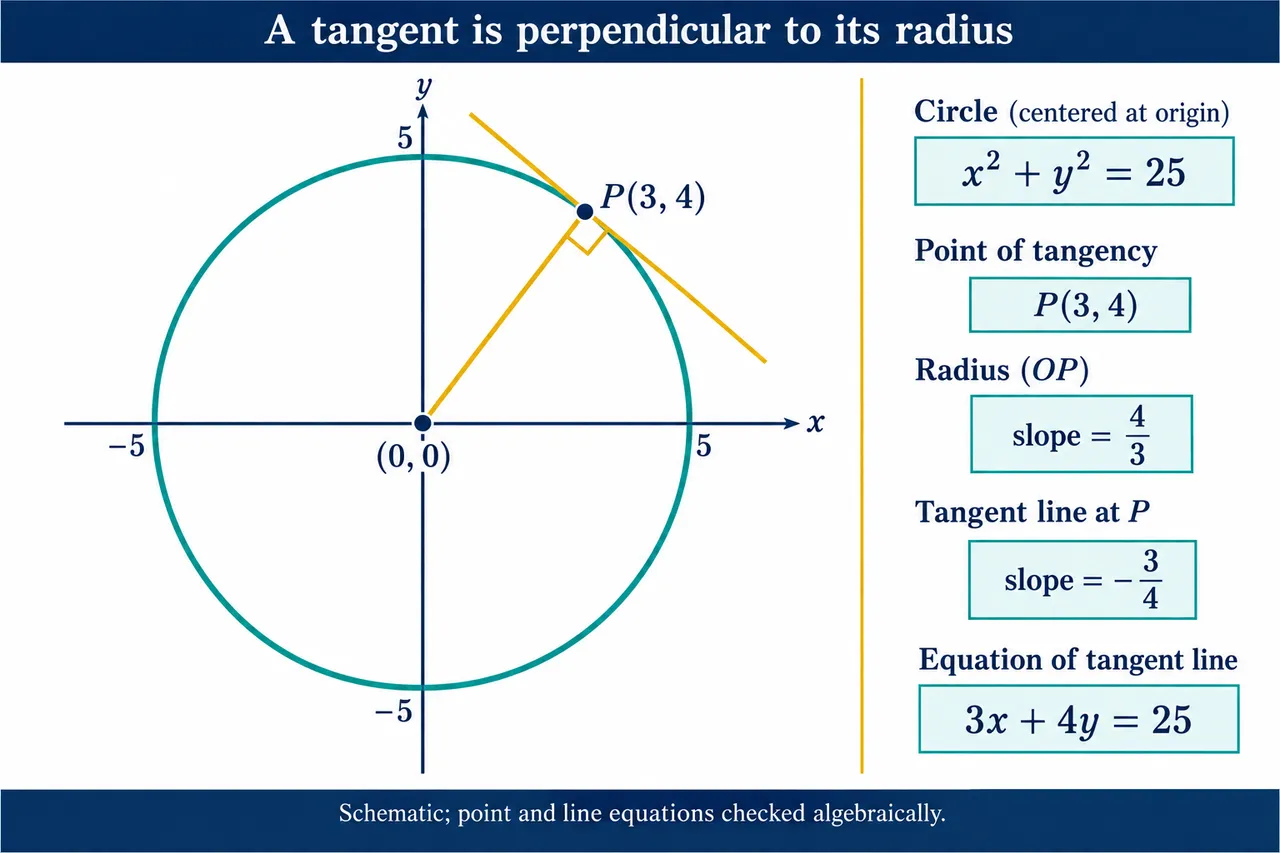
Original myAudience mathematics teaching illustration; labels, relationships and lesson calculations independently checked. · Original project artwork; no exam-board figures or textbook illustrations reused.
Use the equation of a circle centred at the origin
A point on a circle of radius r centred at the origin has horizontal and vertical distances whose squares sum to r². The equation is x² + y² = r². It comes from a right triangle with the radius as hypotenuse.
The radius is the square root of the right-hand constant, not the constant itself. For x² + y² = 25, r = 5. The axis intersections are (±5, 0) and (0, ±5), and the circle has symmetry in both coordinate axes.
Substitution distinguishes points on, inside and outside the circle: compare x² + y² with r². This comparison assumes the usual equal-unit Cartesian geometry; a distorted display can make the circle look oval without changing the equation.
Worked example: Check whether (3, 4) lies on x² + y² = 25.
Square the coordinates separately.
Add 9 + 16.
Compare with 25.
Answer: Yes: the sum is 25.
Check your understanding: What is the radius of x² + y² = 49?
Answer: 7.
Why: The equation contains the radius squared.