Find a tangent at a point on an origin circle
By UK GCSE Mathematics · independent study · myAudience
Original myAudience mathematics teaching illustration; labels, relationships and lesson calculations independently checked. · Original project artwork; no exam-board figures or textbook illustrations reused.
Find a tangent at a point on an origin circle
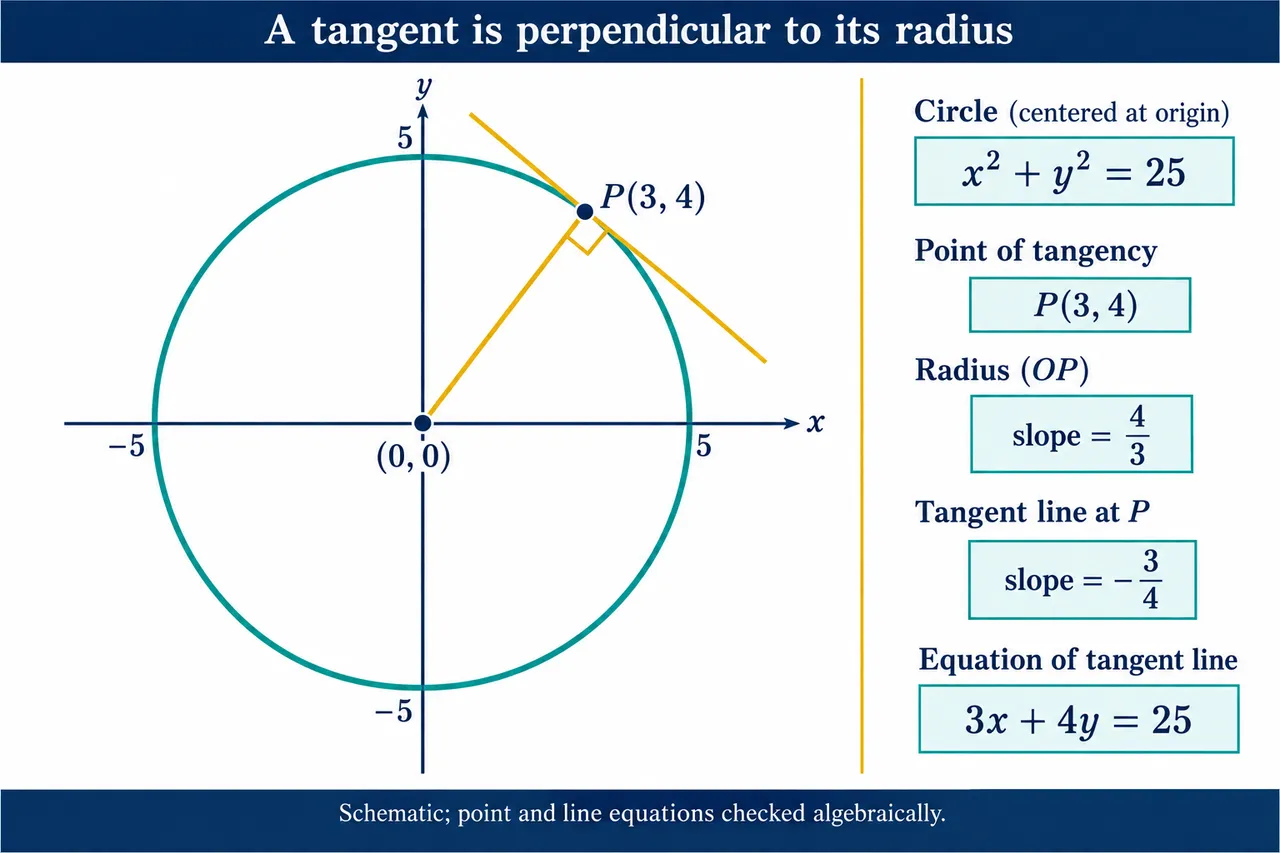
A tangent to a circle is perpendicular to the radius at the point of contact. For P = (3, 4), the radius from the origin has gradient 4/3, so the tangent has gradient −3/4.
Use the contact point as well as the gradient. The equation y − 4 = (−3/4)(x − 3) rearranges to 3x + 4y = 25. Substituting (3, 4) checks that the line reaches the required point; the perpendicular gradients check its direction.
Axis contact points need the horizontal/vertical special case. At (5, 0) on a radius-five circle, the radius is horizontal and the tangent is x = 5. A gradient formula that divides by zero should not be forced into that situation.
Worked example: Find the tangent at (3, 4) on x² + y² = 25.
The radius gradient is 4/3.
Use negative reciprocal −3/4.
Substitute the contact point into point-gradient form and rearrange.
Answer: 3x + 4y = 25.
Check your understanding: What is the tangent at (0, 5) on this circle?
Answer: y = 5.
Why: The vertical radius has a horizontal perpendicular tangent.