Solve a linear equation without breaking equality
By UK GCSE Mathematics · independent study · myAudience
Original myAudience mathematics teaching illustration; labels, relationships and lesson calculations independently checked. · Original project artwork; no exam-board figures or textbook illustrations reused.
Solve a linear equation without breaking equality
An equation asks for inputs that make its two sides equal. Applying the same permitted operation to both sides preserves that equality. Collect variable terms on one side and constant terms on the other, then divide by the remaining nonzero coefficient.
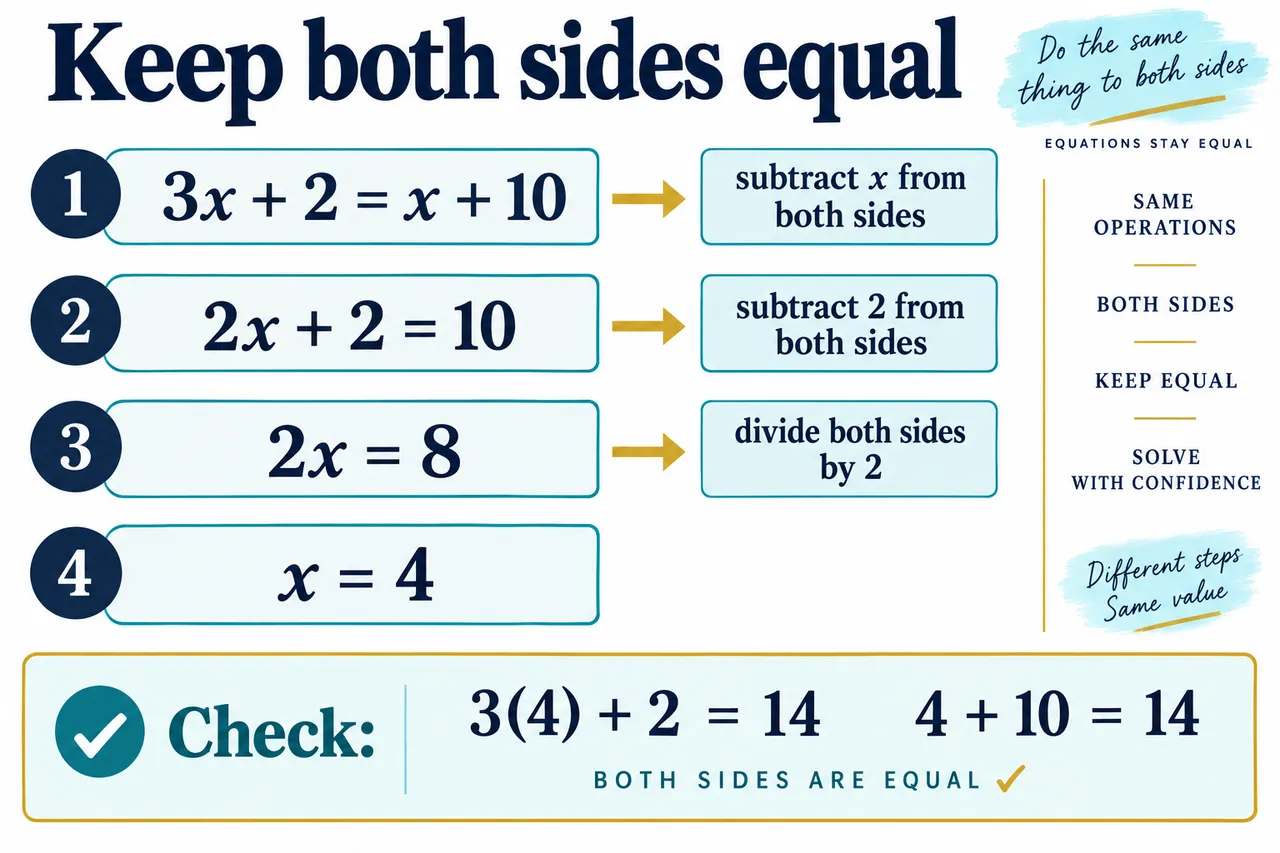
The unknown can appear on both sides. In 3x + 2 = x + 10, subtracting x leaves 2x + 2 = 10. Each step follows from the preceding equation; writing a chain of unrelated expressions joined by equals signs would misrepresent the reasoning.
Check the answer in the original equation, not only in the last simplified line. Some equations have no solutions, such as x + 1 = x + 2; others hold for every allowed input, such as 2(x + 1) = 2x + 2. A zero variable coefficient therefore needs interpretation rather than division by zero.
Worked example: Solve 3x + 2 = x + 10.
Subtract x from both sides: 2x + 2 = 10.
Subtract 2: 2x = 8.
Divide by 2 and check both original sides.
Answer: x = 4; each side becomes 14.
Check your understanding: What does 0x = 5 tell you?
Answer: There is no solution.
Why: No value of x changes the left side from zero.