Use factors to solve a quadratic equation
By UK GCSE Mathematics · independent study · myAudience
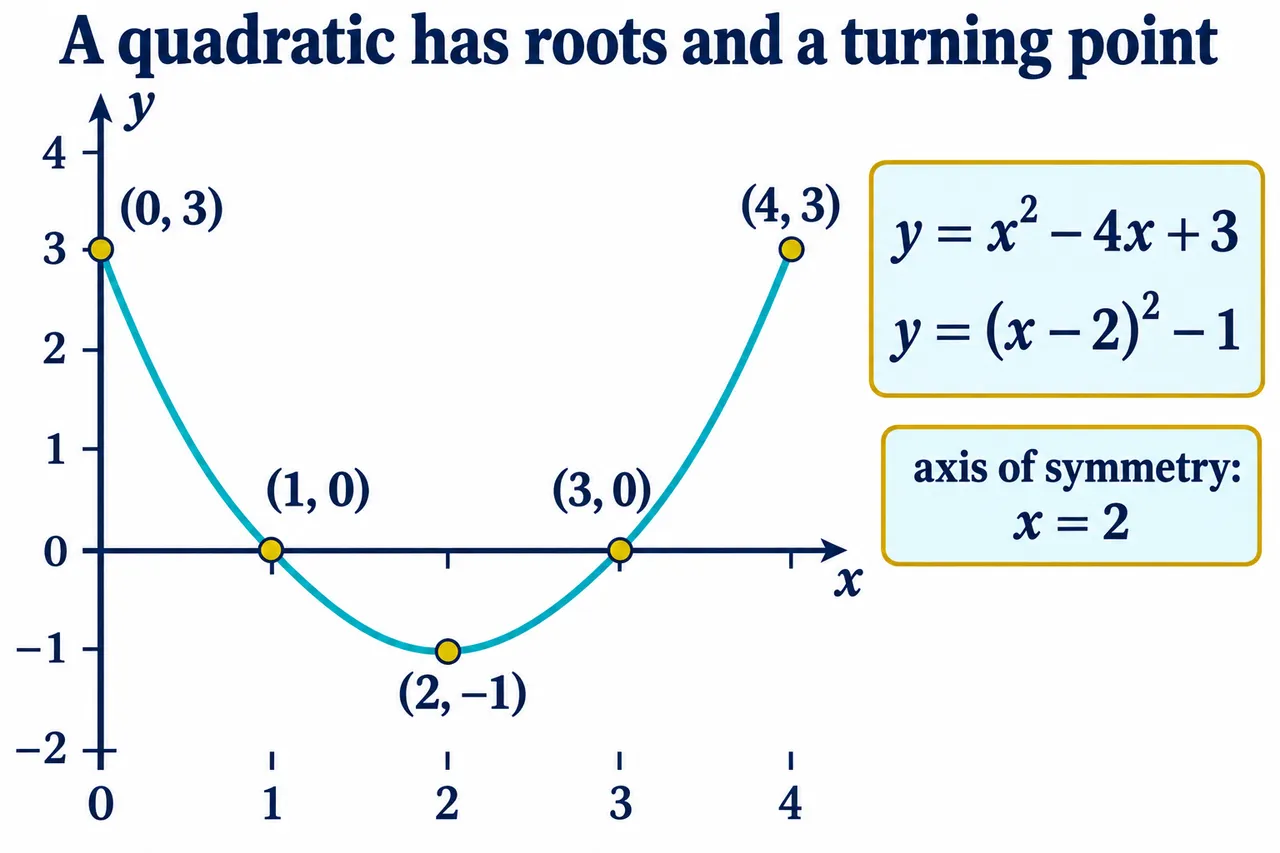
Original myAudience mathematics teaching illustration; labels, relationships and lesson calculations independently checked. · Original project artwork; no exam-board figures or textbook illustrations reused.
Use factors to solve a quadratic equation
First rearrange a quadratic equation so one side is zero. A product is zero when at least one factor is zero. For x² − 4x + 3 = 0, the factorisation (x − 1)(x − 3) = 0 gives two possible inputs.
Keep both roots unless a stated context excludes one. Dividing an equation by an expression involving x can lose a root if that expression could be zero. The graph checks the interpretation: roots are the inputs where the curve crosses or touches the horizontal axis.
A graph can give approximate roots when factorisation is not convenient. A tangent contact with the axis represents a repeated root, while a parabola that stays entirely above or below the axis has no real roots. Reading precision depends on the scale.
Worked example: Solve x² − 4x + 3 = 0.
Factorise as (x − 1)(x − 3) = 0.
Set each factor equal to zero.
Substitute both values into the original equation.
Answer: x = 1 or x = 3.
Check your understanding: Solve x(x − 5) = 0.
Answer: x = 0 or x = 5.
Why: Dividing by x would incorrectly discard the zero root.