Find values satisfying two equations together
By UK GCSE Mathematics · independent study · myAudience
Original myAudience mathematics teaching illustration; labels, relationships and lesson calculations independently checked. · Original project artwork; no exam-board figures or textbook illustrations reused.
Find values satisfying two equations together
A simultaneous solution must satisfy both equations with the same values of the variables. Elimination adds or subtracts equations to remove one unknown; substitution replaces one variable using a relationship from the other equation.
Choose multipliers so the coefficients of one variable match or are opposites. Apply a multiplier to every term of an equation. After finding the first variable, substitute to find the second and check the pair in both original equations.
On a graph, a simultaneous solution is an intersection. Parallel distinct lines have no shared point; identical line equations describe infinitely many shared points. A graphical reading normally gives an estimate, while exact algebra can avoid plotting error.
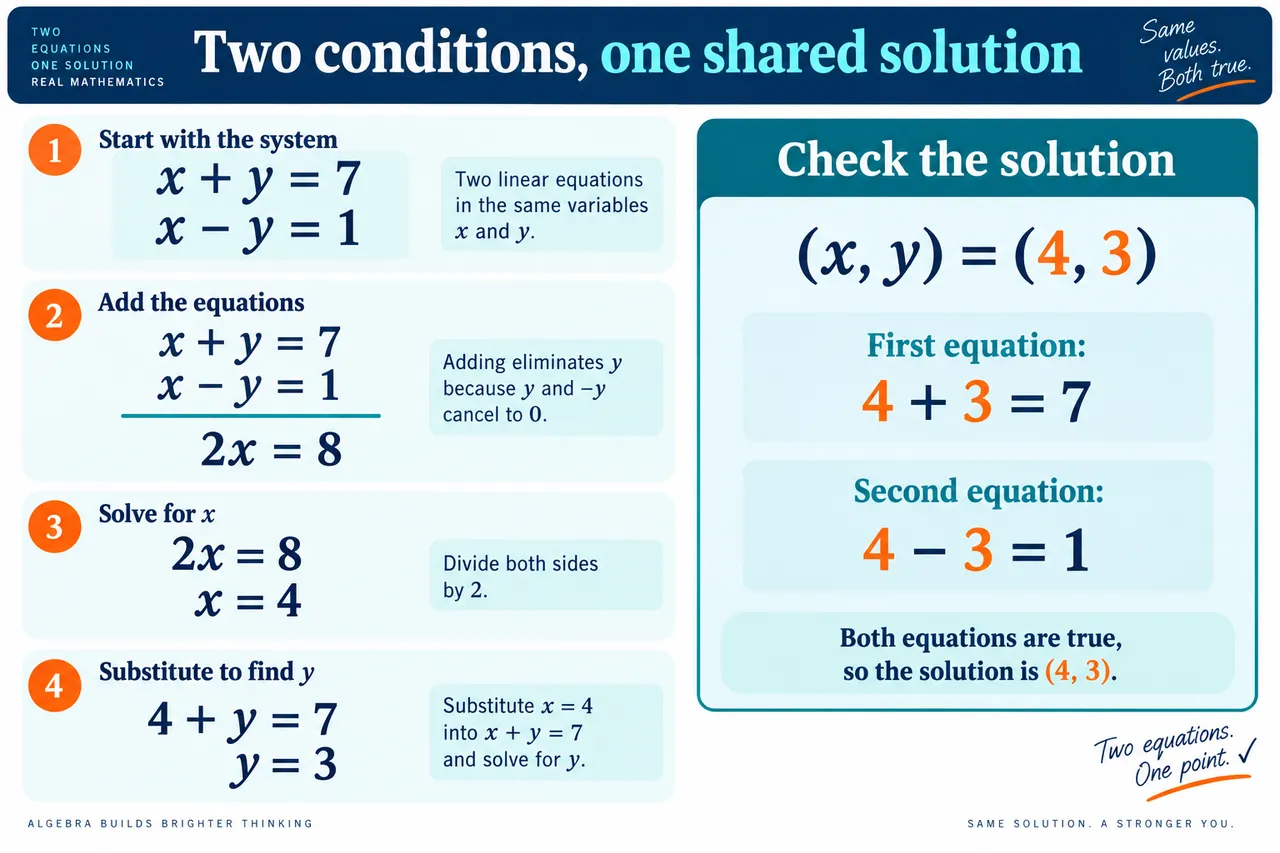
Worked example: Solve x + y = 7 and x − y = 1.
Add the equations to eliminate y: 2x = 8.
So x = 4.
Substitute into x + y = 7 to get y = 3.
Answer: (x, y) = (4, 3).
Check your understanding: Why is (4, 2) not a solution?
Answer: It fails both equations.
Why: 4 + 2 = 6, not 7, and 4 − 2 = 2, not 1. A simultaneous solution must satisfy both original equations.