Translate a situation into equations and interpret the result
By UK GCSE Mathematics · independent study · myAudience
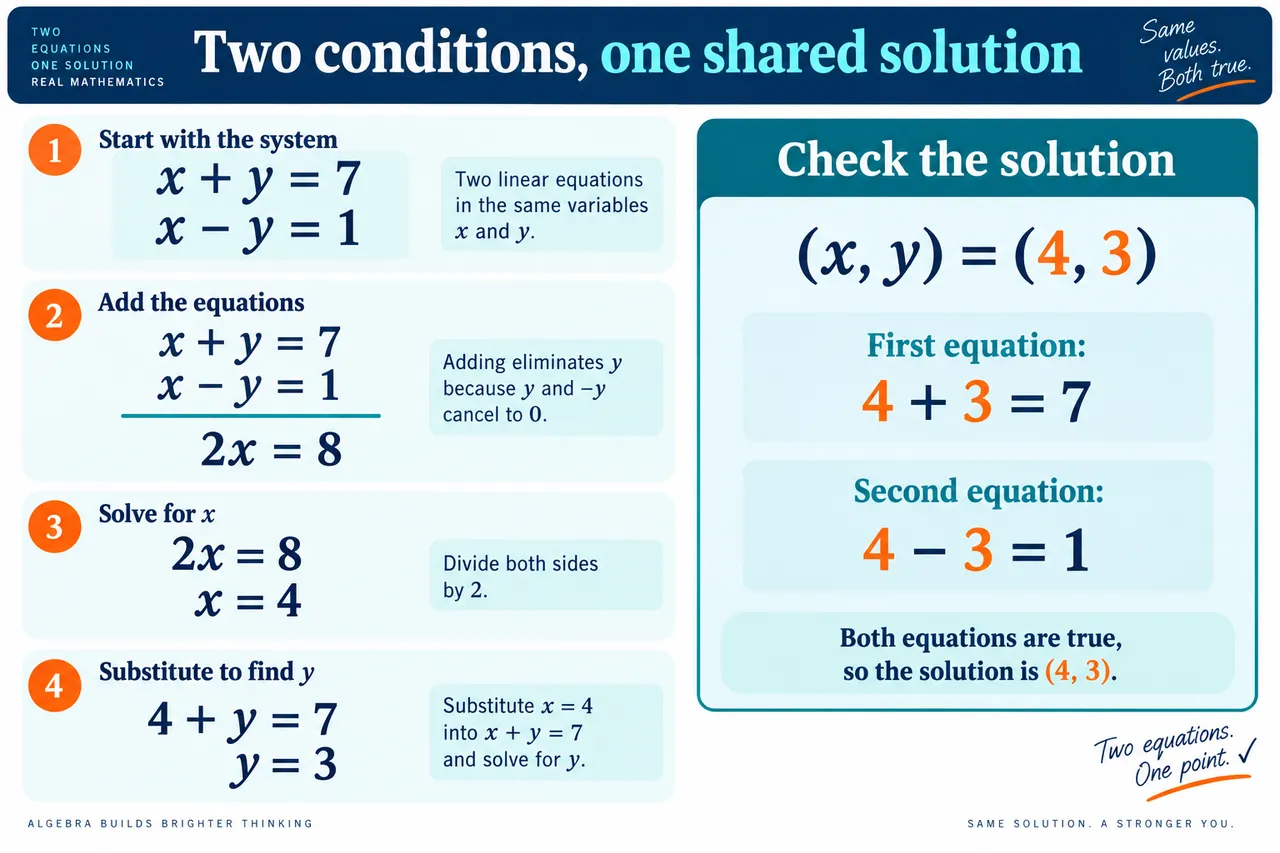
Original myAudience mathematics teaching illustration; labels, relationships and lesson calculations independently checked. · Original project artwork; no exam-board figures or textbook illustrations reused.
Translate a situation into equations and interpret the result
Define each variable before forming a model. The same symbol should retain the same meaning and unit throughout. Distinguish a total from a rate, and identify whether the quantities are continuous or counts of whole objects.
Equations encode the relationships given in the situation. If two prices have a sum and a difference, write both conditions and solve them together. The algebraic answer still needs a contextual check: negative prices or fractional people can signal an invalid model or an excluded solution.
Explain what the answer represents and retain units. An equation can be internally correct while representing the wrong relationship, so substituting the result into the original verbal conditions is as important as checking numerical working.
Worked example: Two ticket prices total £7; the higher price is £1 more. Find both.
Let x be the higher price and y the lower.
Write x + y = 7 and x − y = 1.
Solve and compare with both stated conditions.
Answer: £4 and £3.
Check your understanding: Can a solution of 2.5 be used directly for a number of whole tickets?
Answer: Not without rechecking the model.
Why: The allowed domain is whole-number counts, so an algebraic value can be contextually invalid.