Solve an inequality and represent its solution set
By UK GCSE Mathematics · independent study · myAudience
Original myAudience mathematics teaching illustration; labels, relationships and lesson calculations independently checked. · Original project artwork; no exam-board figures or textbook illustrations reused.
Solve an inequality and represent its solution set
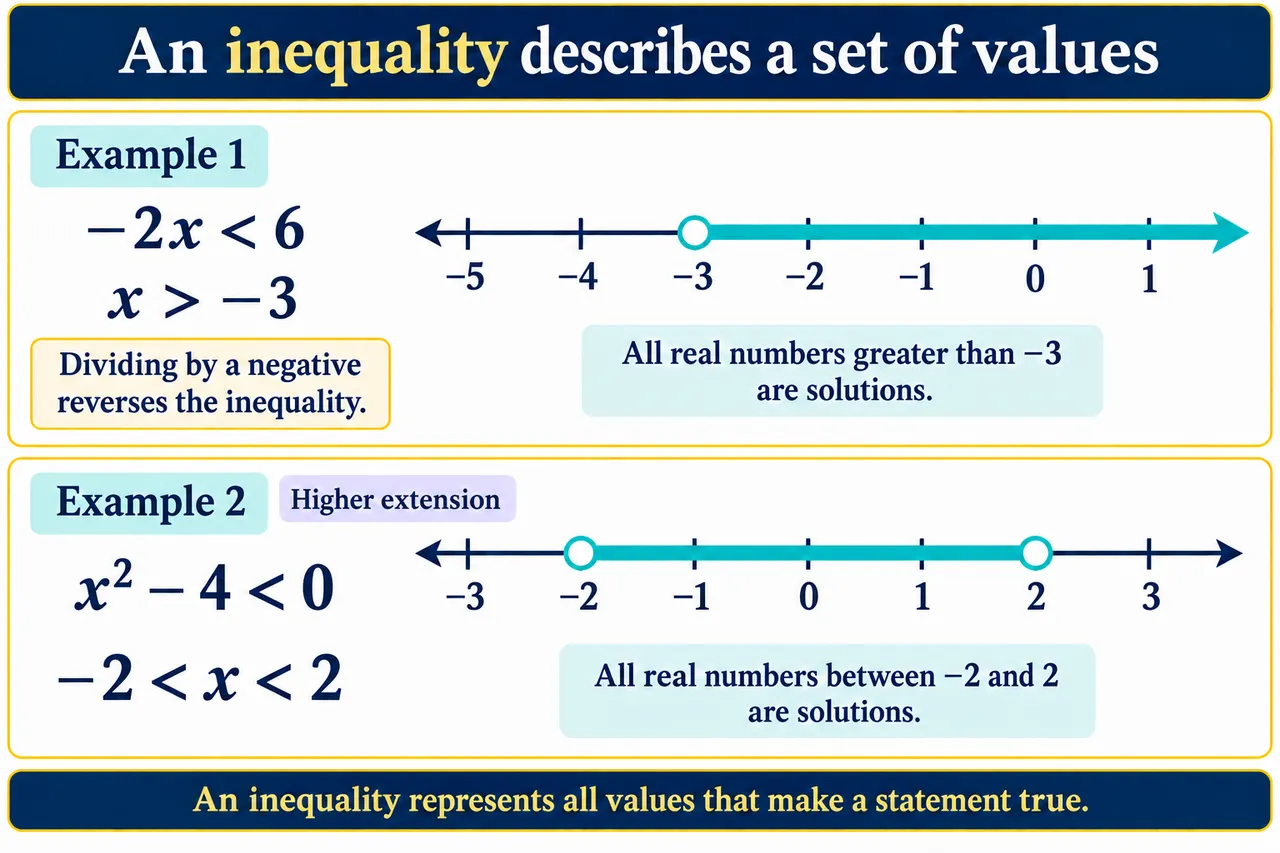
An inequality often describes a range of inputs rather than a single value. Adding or subtracting the same amount preserves its direction. Multiplying or dividing by a negative number reverses the direction because order on the number line is reversed.
Open circles exclude an endpoint and closed circles include it. For x > −3, use an open circle at −3 and shade to the right. For x ≤ 2, include 2 and shade to the left. The display must match whether equality is permitted.
Check a sample inside the proposed range and, when useful, one outside it. This catches a reversed sign. The check supports the algebra but does not replace the general solving steps.
Worked example: Solve −2x < 6.
Divide both sides by −2.
Reverse < to >.
Represent the range with an open endpoint.
Answer: x > −3.
Check your understanding: Does x = −3 satisfy the original inequality?
Answer: No.
Why: It gives 6 < 6, which is false.