Find roots using the quadratic formula
By UK GCSE Mathematics · independent study · myAudience
Original myAudience mathematics teaching illustration; labels, relationships and lesson calculations independently checked. · Original project artwork; no exam-board figures or textbook illustrations reused.
Find roots using the quadratic formula
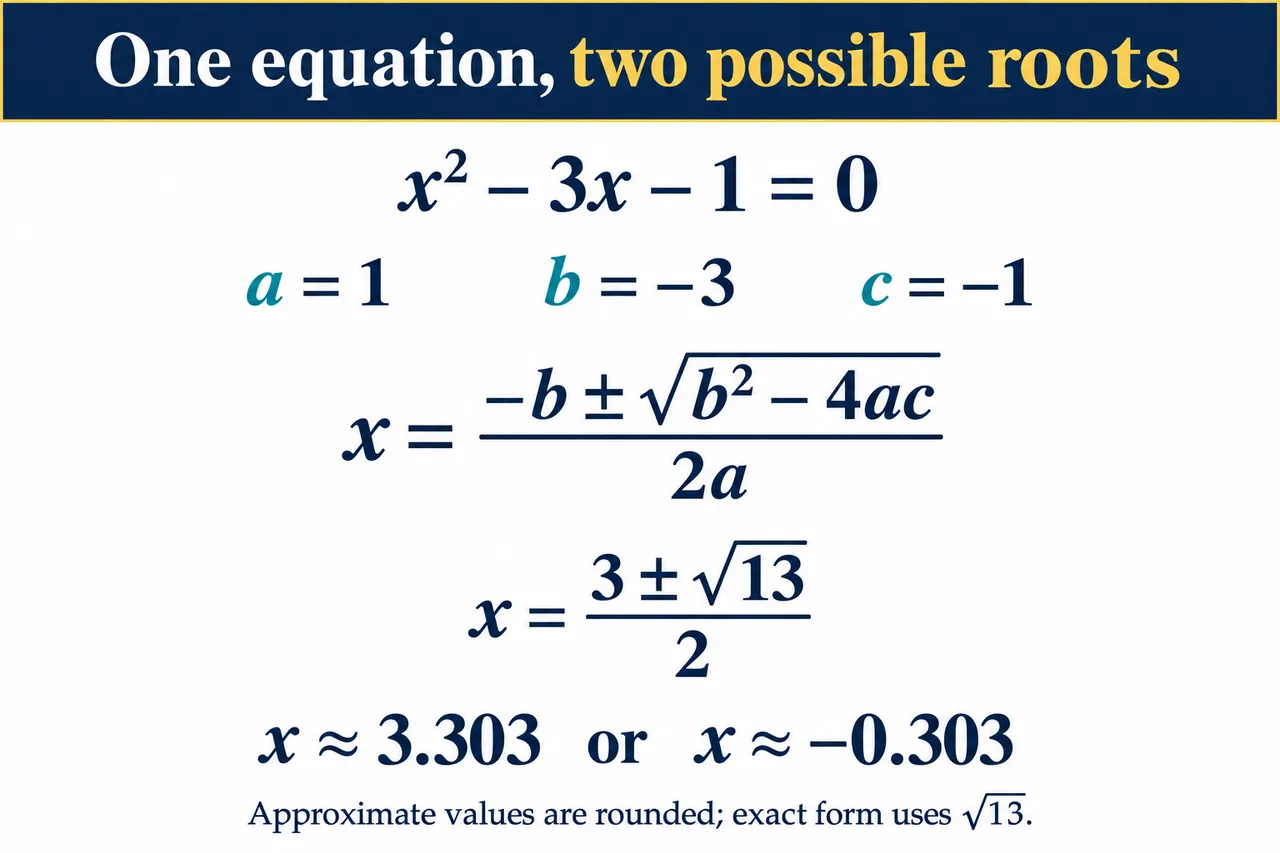
For ax² + bx + c = 0 with a ≠ 0, the quadratic formula gives x = (−b ± √(b² − 4ac))/(2a). First rearrange into this form and identify signed coefficients. The minus sign on b applies to the whole coefficient.
The discriminant b² − 4ac determines the number of real roots: positive gives two, zero gives one repeated root and negative gives none. Keep an exact surd form when required, then round only the final numerical answers.
Both signs in ± must be used. Substitution can check approximate roots by producing a value close to zero; the residual will not usually be exactly zero after rounding. A graph can check the approximate locations but cannot replace precision required by the question.
Worked example: Solve x² − 3x − 1 = 0.
Use a = 1, b = −3, c = −1.
The discriminant is 9 + 4 = 13.
Substitute into the formula and evaluate both signs.
Answer: x = (3 ± √13)/2, approximately 3.303 or −0.303.
Check your understanding: How many real roots does x² + 1 = 0 have?
Answer: None.
Why: Its discriminant is −4.