Solve by completing the square
By UK GCSE Mathematics · independent study · myAudience
Original myAudience mathematics teaching illustration; labels, relationships and lesson calculations independently checked. · Original project artwork; no exam-board figures or textbook illustrations reused.
Solve by completing the square
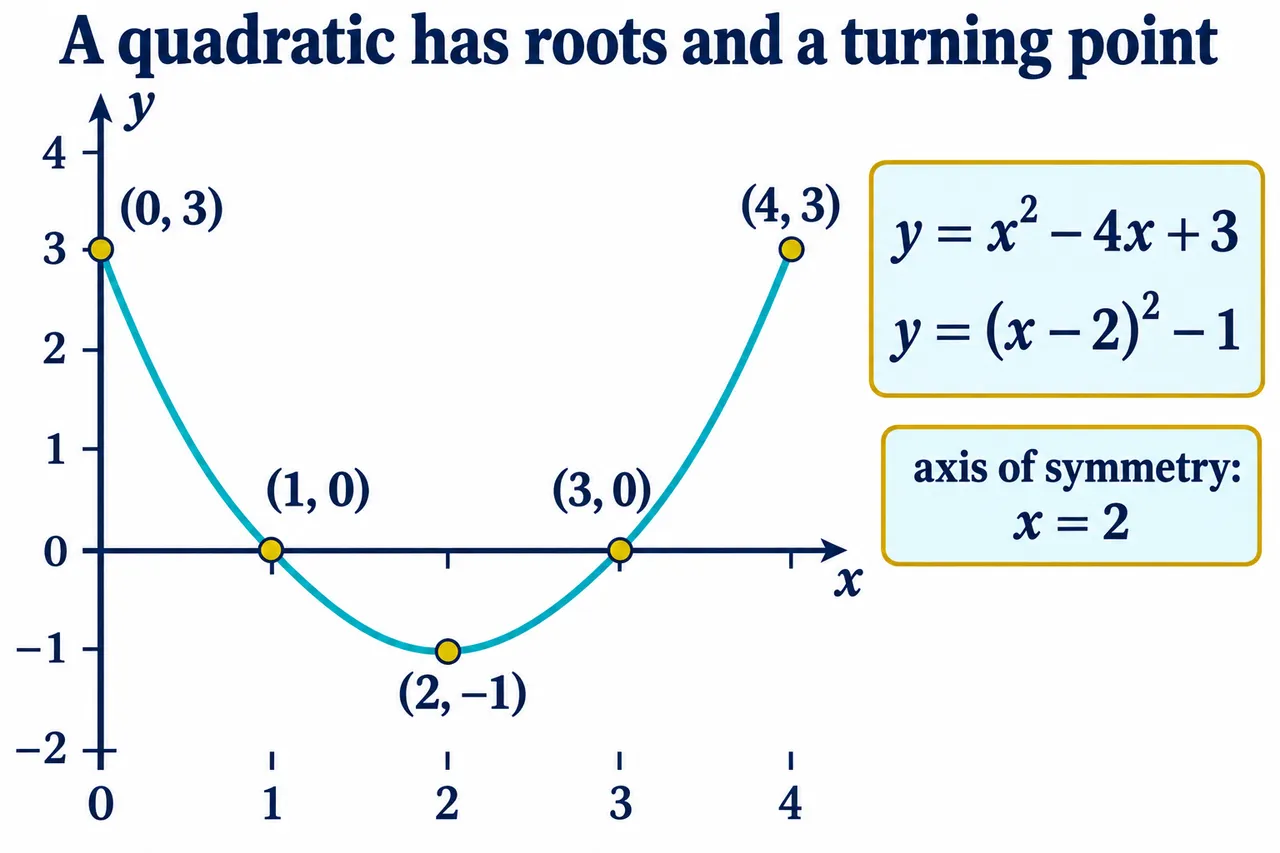
Completing the square can turn a quadratic equation into a squared quantity equal to a constant. For x² − 4x + 3 = 0, the equivalent form (x − 2)² − 1 = 0 gives (x − 2)² = 1.
A positive square on the right normally gives two possibilities: x − 2 = 1 or x − 2 = −1. Using only the positive square root loses a solution. A zero right-hand side gives one repeated root; a negative value gives no real solution.
If the leading coefficient is not one, first handle it consistently. Expand the completed form to verify equivalence before taking roots. The same form shows the turning point, linking the algebra to the graph.
Worked example: Solve x² + 6x + 5 = 0 by completing the square.
Rewrite as (x + 3)² − 4 = 0.
So (x + 3)² = 4.
Use x + 3 = ±2.
Answer: x = −1 or x = −5.
Check your understanding: Why are there two cases when taking a square root here?
Answer: Both 2 and −2 square to 4.
Why: A squared unknown does not have only a positive possible input.