Solve a line and a quadratic together
By UK GCSE Mathematics · independent study · myAudience
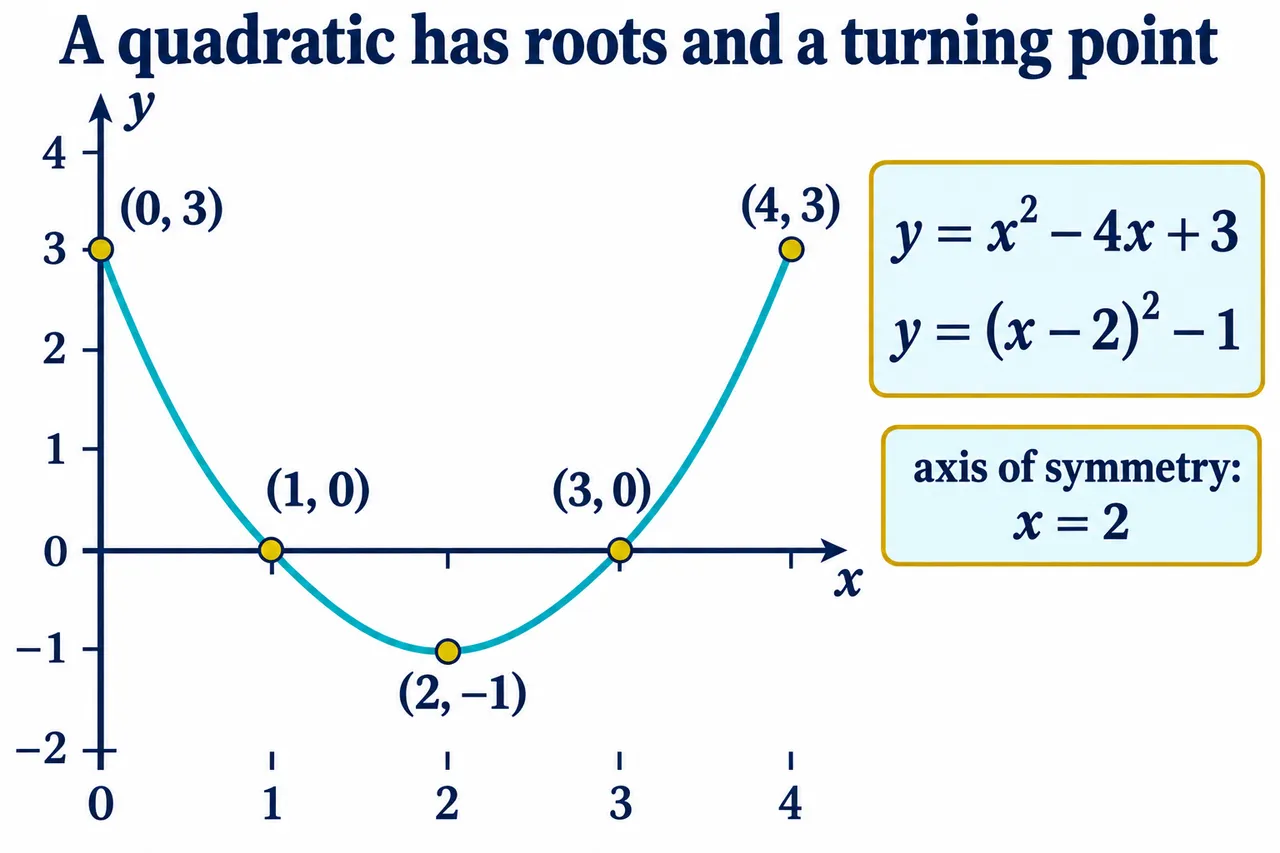
Original myAudience mathematics teaching illustration; labels, relationships and lesson calculations independently checked. · Original project artwork; no exam-board figures or textbook illustrations reused.
Solve a line and a quadratic together
Substitute the linear equation into the quadratic relationship to reduce the system to one unknown. Solve the resulting quadratic and then recover the second variable for every root. Each resulting pair must satisfy both original relationships.
A line and a parabola can meet twice, touch once or have no real intersection. Algebra and the graph describe the same alternatives. Finding two x-values is not enough: the answer is a set of coordinate pairs.
Keep exact values through substitution to avoid mismatched rounding. When context limits the domain, explain which solutions are permitted rather than silently deleting inconvenient roots.
Worked example: Solve y = x + 1 and y = x² − 1.
Equate outputs: x² − 1 = x + 1.
Rearrange and factorise: (x − 2)(x + 1) = 0.
For each x, use y = x + 1.
Answer: (2, 3) and (−1, 0).
Check your understanding: How many intersections can a line and a parabola have in general?
Answer: Zero, one or two.
Why: The substituted quadratic can have zero, one repeated or two real roots.