Use iteration to approximate a root
By UK GCSE Mathematics · independent study · myAudience
Original myAudience mathematics teaching illustration; labels, relationships and lesson calculations independently checked. · Original project artwork; no exam-board figures or textbook illustrations reused.
Use iteration to approximate a root
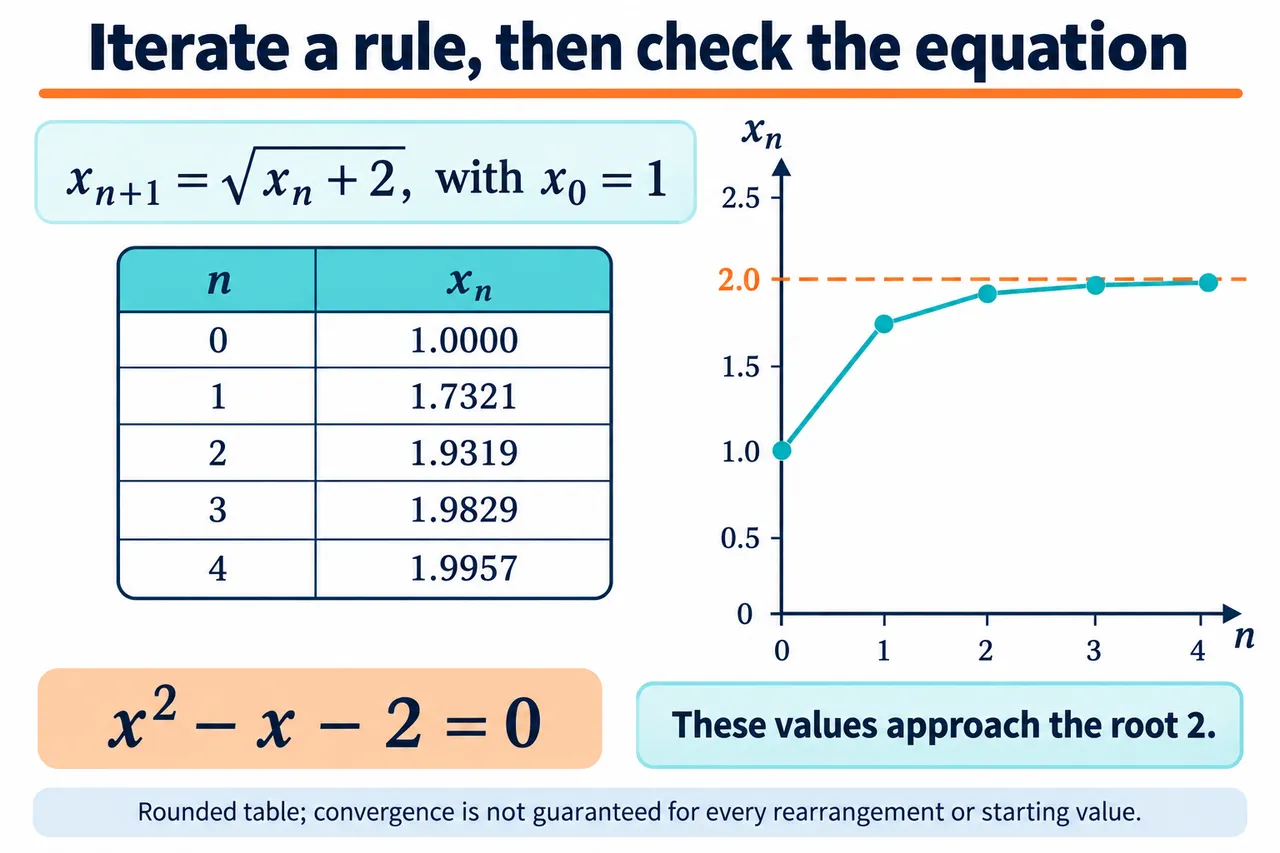
Iteration repeatedly applies a rearranged equation as a rule for the next approximation. For x² − x − 2 = 0, one possible rule is xₙ₊₁ = √(xₙ + 2). Starting at x₀ = 1 gives values approaching the positive root 2.
A rearrangement and starting value can converge, diverge or approach a different solution. This square-root rule cannot produce negative outputs, so it does not find the root −1. Record enough working precision to judge whether the requested rounded answer has stabilised.
Check a candidate in the original equation and examine whether the sequence is genuinely converging. Agreement of a few rounded values is practical evidence for an approximation, not proof that every possible iteration method works.
Worked example: Use the rule xₙ₊₁ = √(xₙ + 2) from x₀ = 1 for two steps.
x₁ = √3, approximately 1.7321.
x₂ = √(√3 + 2), approximately 1.9319.
Retain unrounded values when continuing.
Answer: The first two new estimates are approximately 1.7321 and 1.9319.
Check your understanding: Will this rule find the root −1?
Answer: No.
Why: Its square-root output is nonnegative.